

Medical traceability solutions for UDI labeling, Device History Records, and fast, narrow recalls.
When a device or supply lot needs to be recalled, the difference between pulling ten units and ten thousand comes down to how tightly your traceability record is built.
KnarrTek’s medical traceability solutions, BellHawk and MilramX, give medical device and medical supply manufacturers and distributors real-time lot and serial tracking, UDI labeling, and an audit-ready Device History Record for every unit, so a recall stays as narrow as the problem that caused it.
- Lot + Serial Tracking
- UDI Labeling
- Device History Records
- Barcode + RFID
- Sterilization + Lot Control
- ERP Integration
What KnarrTek medical traceability solutions do for medical device and supply operations
BellHawk and MilramX are not paperwork you assemble after the fact when an auditor or a complaint shows up. They are the system that captures lot, serial, and component data the moment it moves, so a Device History Record is already built by the time anyone asks for it.
Medical traceability solutions matter because device and supply records have to answer hard questions quickly: which components went into this device, which sterilization load did it ride in, which label was applied, and where did it ship? When those answers live in paper travelers, spreadsheets, and separate systems, the search itself becomes the problem. KnarrTek builds the answers into the daily work.
Real-Time Lot & Serial Tracking
Barcode and RFID scans update component, lot, and device status the moment they move, so what is in the system matches what is on the line.
UDI Labeling
Unique Device Identification labels are generated from the same record that tracks the device, so the label always matches the history behind it.
Audit-Ready Device History Records
Every scan writes to the record automatically, so a DHR is assembled as work happens instead of reconstructed the week before an audit.
Narrow, Fast Recalls
One-step-forward and one-step-back traceability helps you identify which units are connected to an issue, instead of pulling an entire lot to be safe.
Lot, serial number, UDI, and Device History Record: how medical traceability solutions keep them straight.
Devices or components made together.
A lot or batch groups units with a shared origin, so a problem can be scoped to the units that share it.
One individual device.
A serial number leads to one unit’s components, build steps, sterilization load, and shipment.
Device identifier plus production identifier.
The device identifier names the product and version. The production identifier carries lot, serial, expiration, or manufacture date.
The production record.
A Device History Record shows what went into a device, how it was built, tested, sterilized, labeled, and shipped.
The traceability gaps medical device and supply operations deal with today
These challenges show up across device manufacturers, medical supply distributors, and multi-site operations alike, and they are the ones KnarrTek’s medical traceability solutions are built to close.
Recall Scope You Can’t Control
Without lot- and serial-level traceability, a single defect can force a recall of an entire production run instead of the units actually affected.
Manual Device History Records
Assembling a DHR by hand from paper travelers and separate spreadsheets eats staff time and leaves gaps that are hard to explain during an inspection.
Fragmented Systems & Manual Records
When the ERP, quality system, and paper logs do not talk to each other, staff spend real time reconciling records instead of moving product through the line.
Rising Operational Costs
Manual data entry, rework from transcription errors, and duplicate systems add hidden cost that is hard to see until it is added up over a year.
Medical device traceability solutions: what BellHawk does for device and supply operations
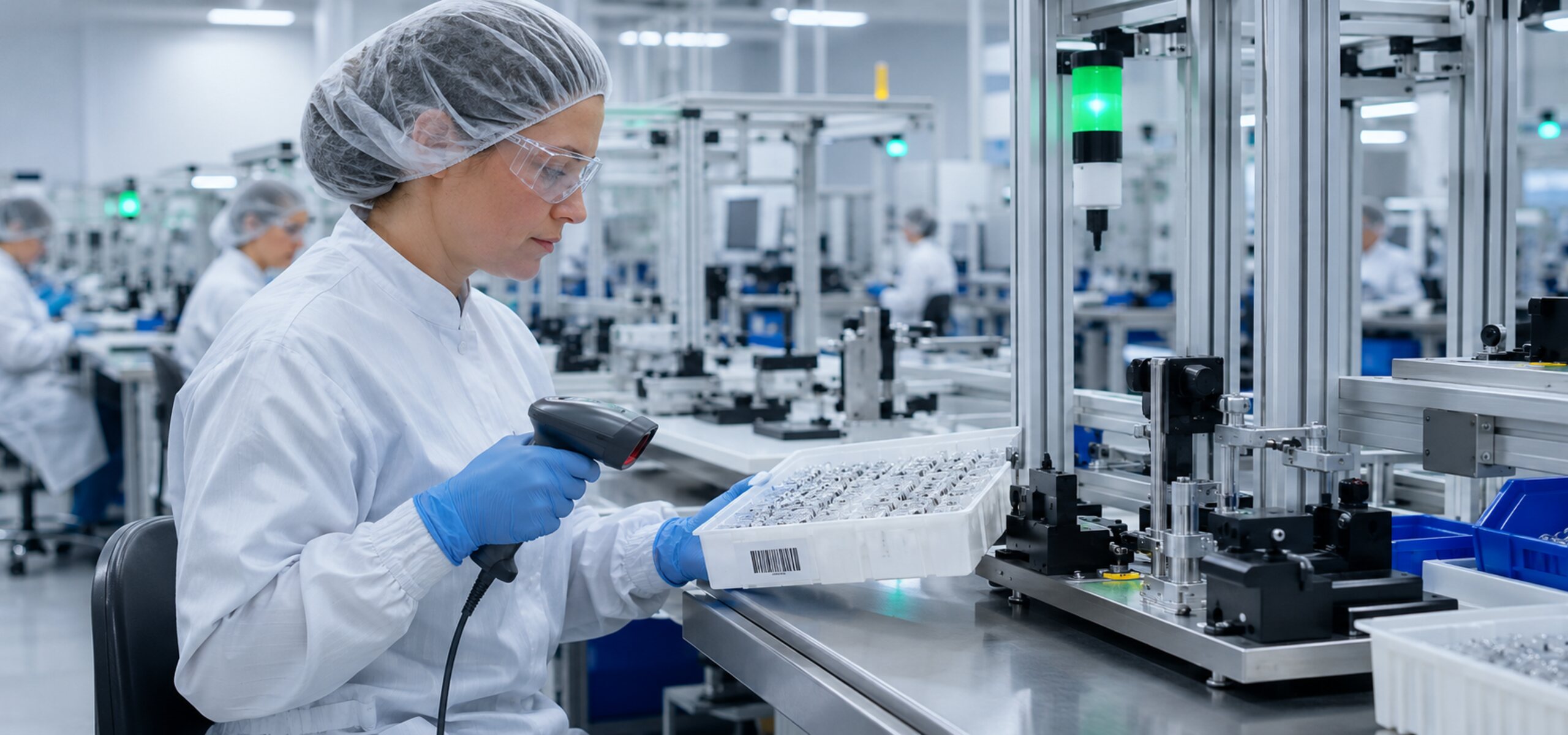
BellHawk is the engine behind KnarrTek’s medical traceability solutions: a Manufacturing Execution System (MES) and Warehouse Management System (WMS) for medical device and medical supply manufacturers and distributors. It replaces paper forms and manual data entry with barcode scanning and mobile devices so every lot, component, and finished device is tracked in real time.
Materials & Lot Tracking
Monitor components and finished devices by lot and serial number, storage location, expiration date, and quality status across every site.
One-Step Traceability
Capture data on the components used in every device, enabling forward and backward traceability to pinpoint defect origins and narrow recall scope.
Quality Assurance
Document production steps, including quality checks and test results, to support GMP-aligned quality standards and your internal requirements.
UDI Label Automation
Generate UDI and GS1 barcode labels configured for specific products and customers, keeping labels accurate and consistent with the record.
Operational Visibility
Real-time insight into inventory, production progress, equipment usage, labor, and order fulfillment across every site.
ERP Integration
MilramX synchronizes inventory, production, and quality data with ERP and other business systems, reducing duplicate data entry.
How medical traceability solutions connect component receiving to the Device History Record, in real time
Components, lots, and finished devices are scanned by barcode and RFID at receiving, assembly, sterilization, and shipping into the BellHawk engine as work happens. BellHawk records lot, serial, and location data, tracks quality checks and sterilization cycles across every workflow, and generates UDI labels at each step. That record feeds the data MilramX uses to trigger rules-based alerts on quality holds or delays, assemble the audit-ready Device History Record, and synchronize selected data with ERP and other business systems.
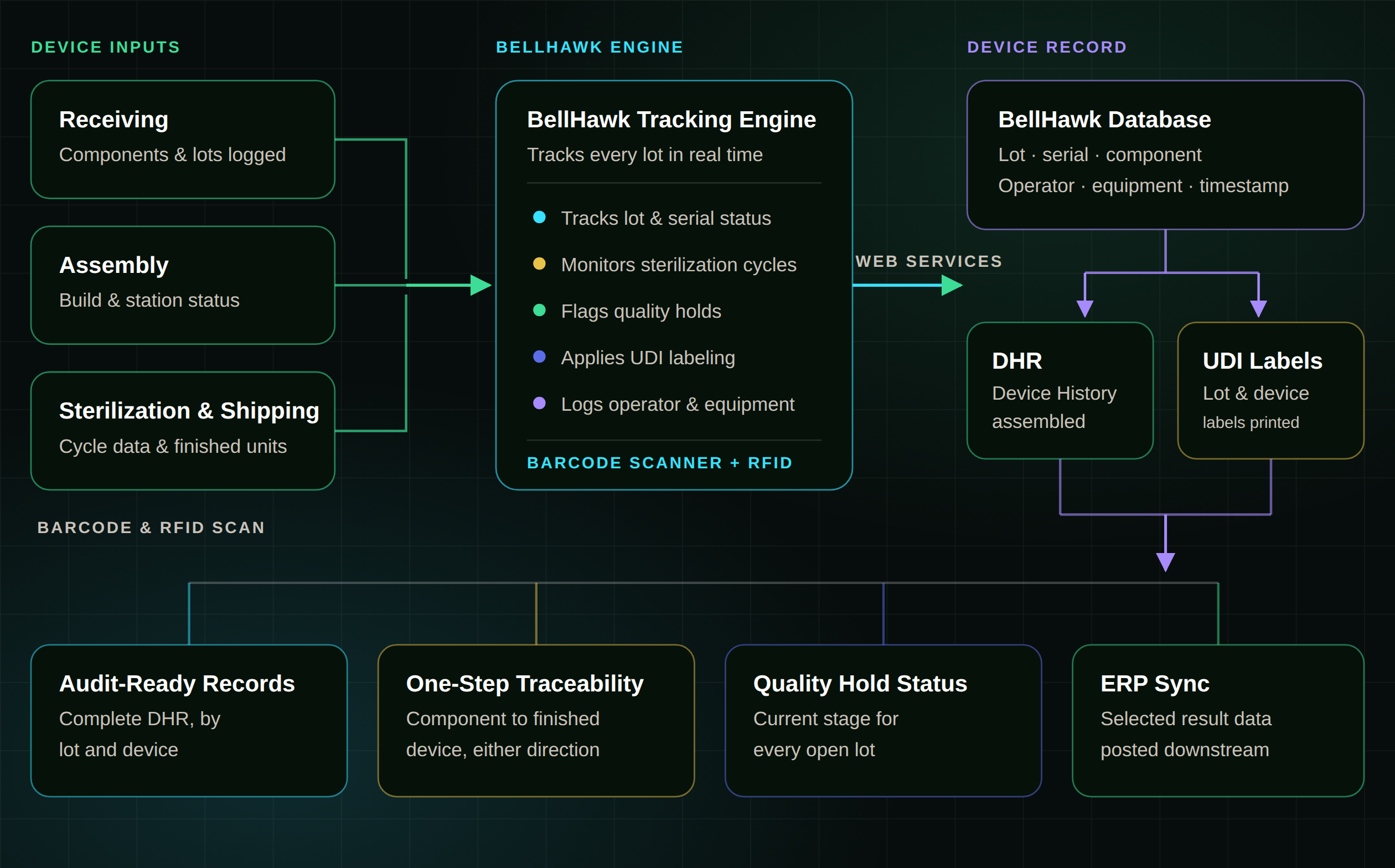
- Barcode and RFID capture at receiving, assembly, sterilization, and shipping.
- Real-time lot and serial status tracked across every site.
- One-step traceability linking every component to every finished device.
- Rules-based alerts flag quality holds, delays, or missed process steps.
- Offline store-and-forward capture keeps line staff moving without a live connection.
- Selected data synchronized to ERP and other systems via MilramX.
How medical traceability solutions follow a device through production
Each of these stages is a real sequence a BellHawk-enabled operation follows, and each one writes something to the record. A Device History Record builds itself, recalls stay narrow, and downstream systems stay current automatically instead of by hand.
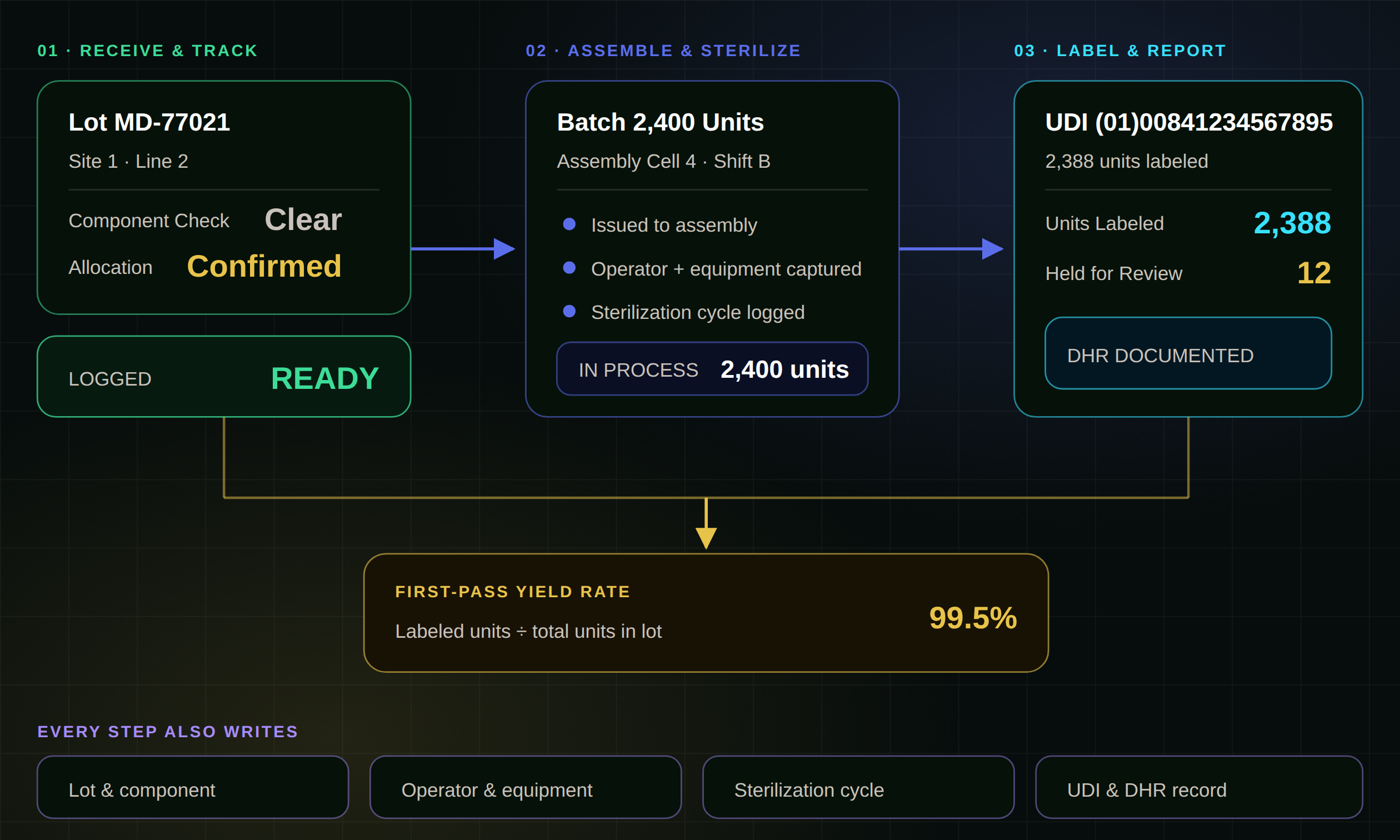
Receive & Track
Components and materials are scanned on arrival and allocated to a lot or work order, with source, quantity, and location recorded.
Assemble & Sterilize
Assembly and sterilization steps are validated in real time, with operator, equipment, and cycle data captured at every step.
Label & Report
UDI labels and the Device History Record are generated at completion, and results sync to ERP and other systems for reporting.
Device History Records and UDI labeling, built as work happens
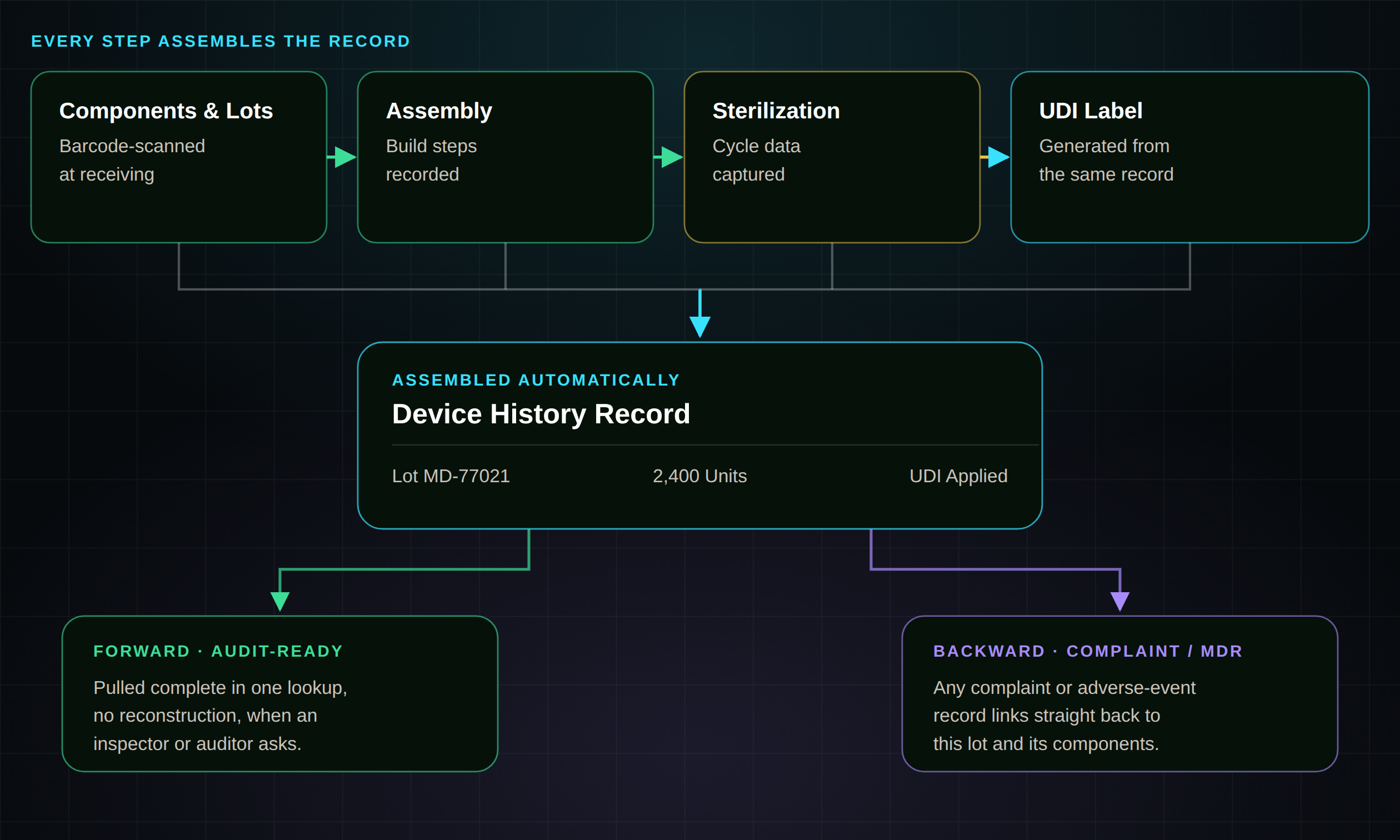
A Device History Record is only useful if it is complete and fast to pull. With KnarrTek’s medical traceability solutions, BellHawk assembles the DHR automatically as components are received, assembled, sterilized, and labeled, and links it to complaint or adverse-event records, so the full history of a device is one lookup away instead of a week of digging through paper travelers.
UDI Label Generation
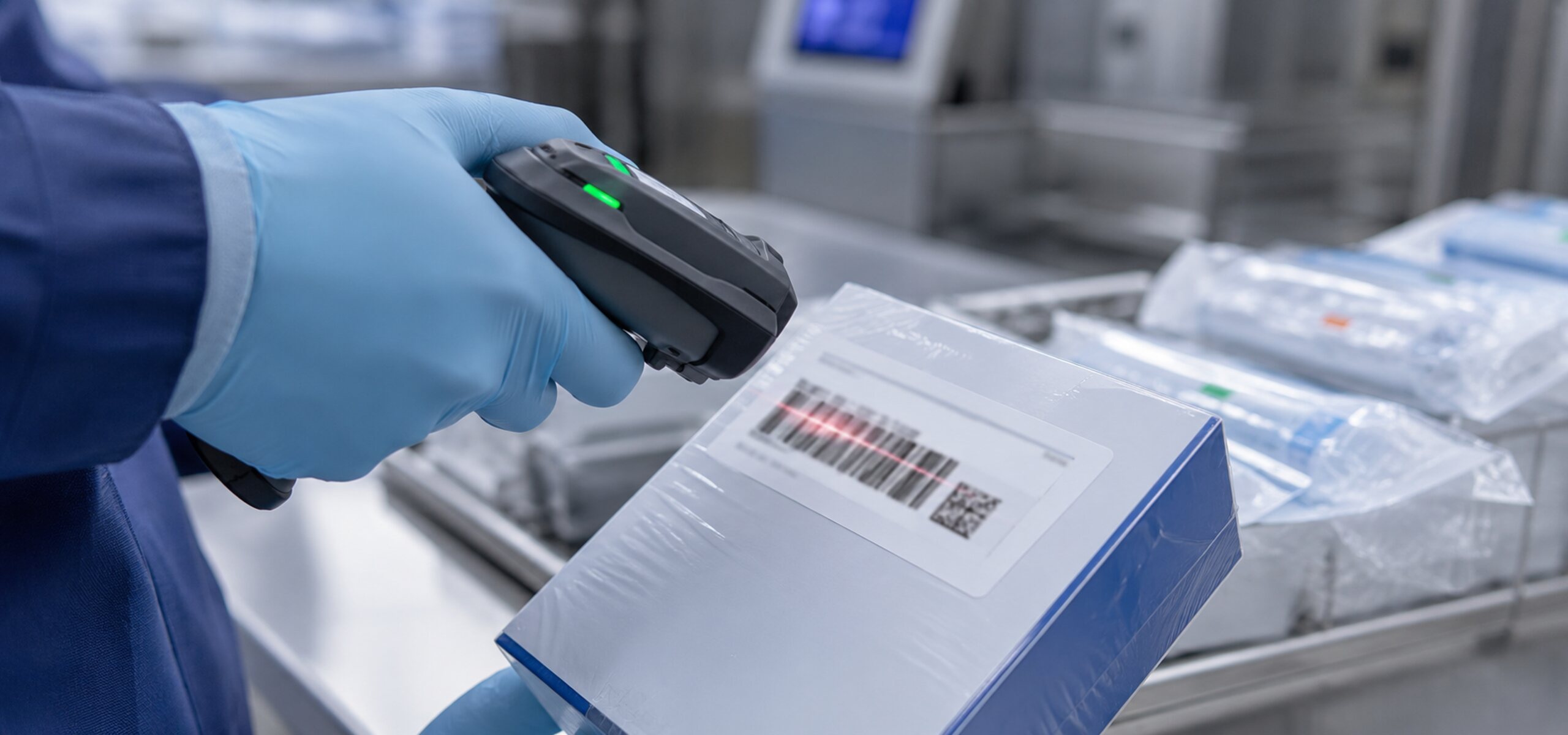
Unique Device Identification labels are generated directly from the production record, so the label on the box always matches the history behind it.
Device History Record Assembly
Every receipt, build step, sterilization cycle, and quality check writes into the same record, assembling the DHR automatically instead of by hand.
Complaint & Adverse-Event Linkage
A complaint or adverse-event record links back to the specific lot and components involved, so investigations start with the record instead of a search.
UDI labeling from medical traceability solutions that matches the record behind every device.
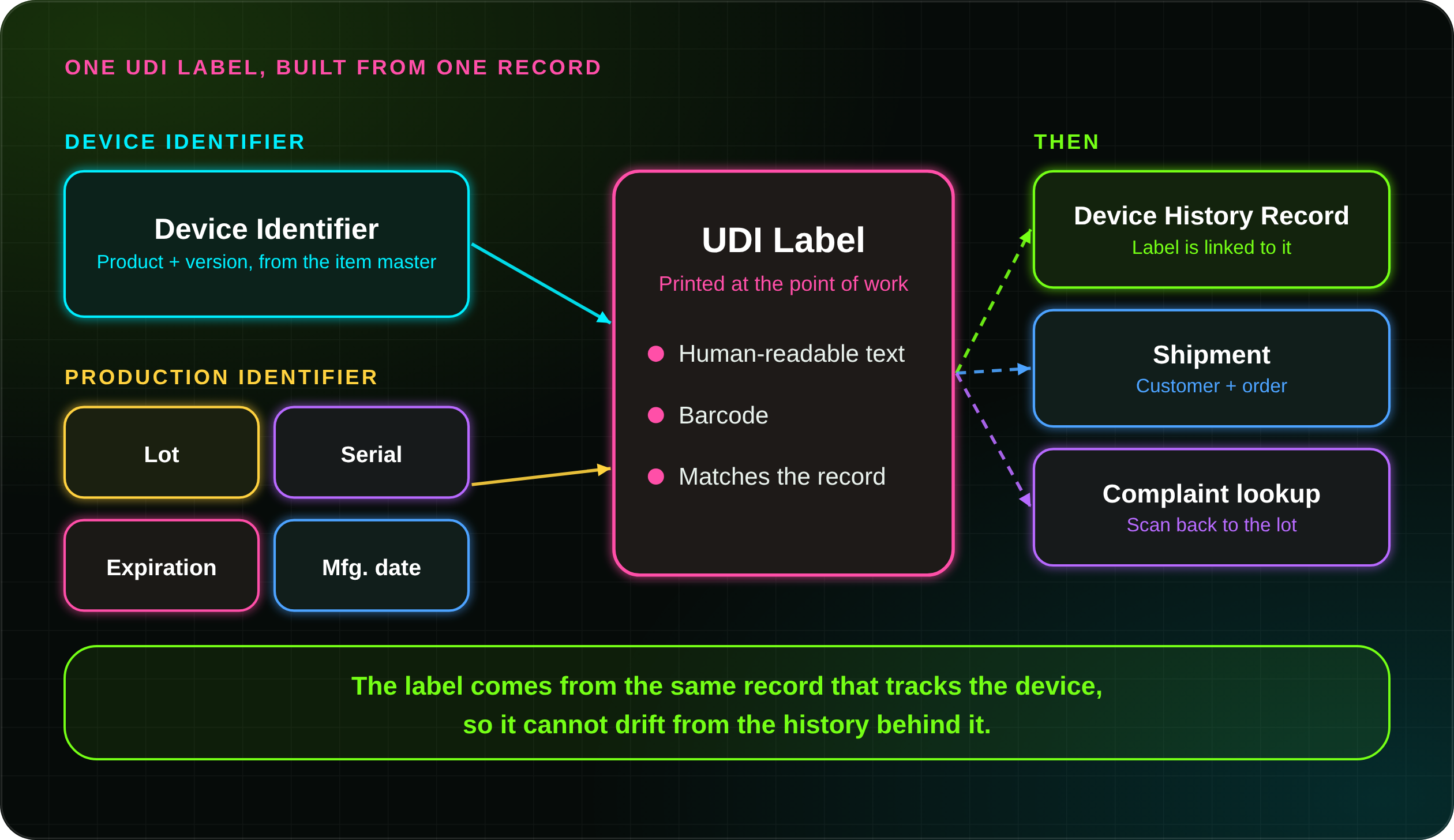
A Unique Device Identifier has two parts. The device identifier names the product and version. The production identifier carries the information that changes from unit to unit: lot or batch, serial number, expiration date, and manufacture date. UDI labeling goes wrong when someone types those values onto a label by hand, or when the label system is separate from the production record.
BellHawk, the core of KnarrTek’s medical traceability solutions, generates UDI labels from the production record at the point of work, so the production identifier printed on the label is the same data stored in the Device History Record. Label formats are configured with your team for each product and customer. Submitting device data to FDA’s GUDID database is a separate step that stays with your regulatory team.
- Print at the point of work: labels come from the same scan that records the build step.
- Match the record: lot, serial number, expiration, and manufacture date come from the production record, not retyping.
- Link to history: each printed label is tied to the Device History Record and the shipment.
- Look up from the label: scanning a label leads back to the lot and components for a complaint investigation.
Record every sterilization load, hold, and release against the lots involved.
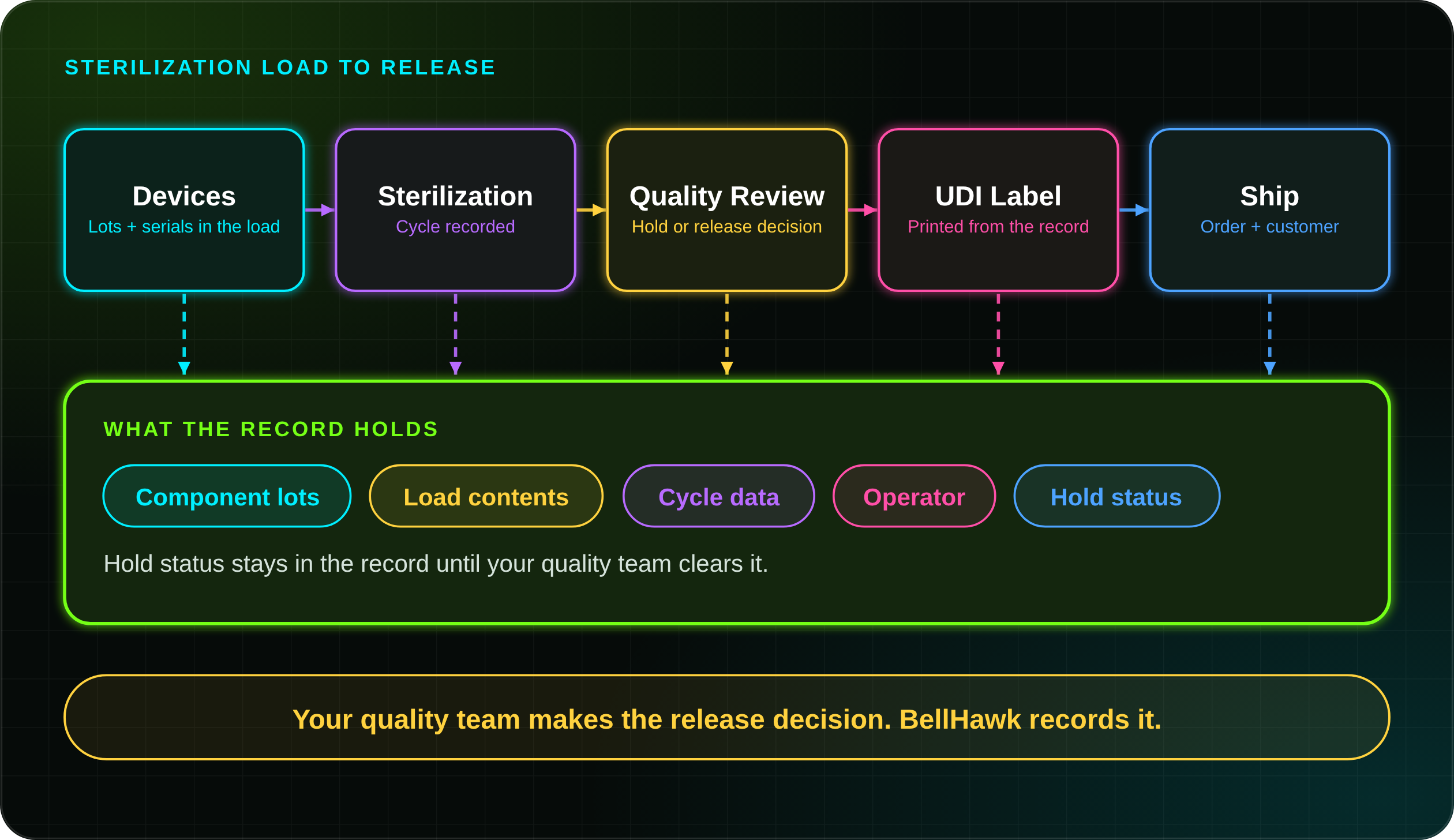
Sterilization is where lot control matters most for medical traceability solutions. If a load has a problem, the question is which devices were in it. BellHawk records which lots and serial numbers rode in each load, the cycle and equipment used, the operator, and the result, so a sterilization issue leads straight to the affected units.
Load contents
Scan the lots and serial numbers into the load so the record shows exactly what was sterilized together.
Holds stay visible
Quality holds stay in the record until your quality team clears them, and MilramX can alert on a hold or a delay.
Release is your decision
BellHawk records the release decision and links it to the label and shipment. Quality and regulatory teams make the decision.
Deployment flexibility for medical device and supply environments
KnarrTek’s medical traceability solutions adapt to how and where operations actually run, supporting minimal disruption during implementation and long-term scalability as your site count and production volume grow.
Browser-Based Access
Cloud-hosted tracking for inventory, lots, and production status, visible the moment they are scanned, with no local server to maintain.
Rugged Mobile & Offline Capture
Mobile devices capture barcode and RFID scans on the line even with limited connectivity, synchronizing automatically once a connection is restored.
Multi-Site Networks
Data capture stays local at each site while centralized dashboards give leadership real-time visibility across every location.
Where MilramX extends BellHawk with automation
Within KnarrTek’s medical traceability solutions, MilramX turns BellHawk’s real-time scan data into action. It automates workflows and synchronizes information across ERP and other systems, so quality and operations teams see problems as they happen instead of at the next status meeting.
Smart Automation
An intelligent-agent framework manages parallel tasks like data transfers and notifications, streamlining operations without constant manual oversight.
Data Integration
Collects and processes data from multiple systems into High Level Data Objects (HLDOs), simplifying management and keeping every report consistent.
Operations Dashboard
Monitors purchase orders, work orders, move orders, and shipments in real time for enhanced oversight across the operation.
Error Management
Automated error detection and correction supports continuous operation, with alerts for IT support when something needs a human look.
Adaptable Integration
Connects with ERP, CRM, and other systems, adapting to diverse medical device and medical supply applications as your requirements change.
Rules-Based Alerts
Flag quality holds, delays, or missed process steps while the work is still in progress, so the right person sees them early.
6 essential benefits of medical traceability solutions from KnarrTek
KnarrTek’s medical traceability solutions tackle the problems that cost operations time, money, and recall exposure: manual Device History Records, fragmented systems, and rework from avoidable errors.
Rapid, Narrow Traceability
One-step-backward and one-step-forward tracking helps pinpoint which lots and units are connected to an issue, minimizing recall scope.
Less Rework and Manual Entry
Scanning replaces retyping, which reduces transcription errors, duplicate entry, and the rework that follows. Results vary by operation.
Enhanced Safety
Tracking materials, personnel, and process steps together helps mitigate risk and supports patient safety and quality-standard recordkeeping.
Operational Efficiency
Real-time visibility and automation reduce manual processes and improve inventory, production, and quality management together.
Scalability
Tailored for small to mid-sized organizations and multi-site operations alike, with configurations that fit your specific product lines.
Audit-Ready Documentation
Device History Records and UDI labeling documentation are assembled automatically, ready the moment an inspector or auditor asks for them.
Compliance note: BellHawk supports your documentation and recordkeeping. It does not certify a business or a product, and compliance responsibility remains with the customer.
Two ways medical traceability solutions are deployed
BellHawk and MilramX support a range of deployment shapes. These are representative patterns rather than a specific operation’s results, described so you can recognize which one resembles your own.
One-step traceability and UDI labeling tied to a single production record
Every lot is built, sterilized, and labeled against the same record, with no separate spreadsheet tracking which units are already labeled.
A single-site device manufacturer deploys BellHawk to log components at receiving, track assembly and sterilization in real time, and generate UDI labels and Device History Records automatically. MilramX synchronizes results with the operation’s ERP, so quality holds and releases stay consistent no matter who is reviewing them.
What this pattern is intended to improve: faster DHR assembly, narrower recall scope if one is ever needed, and less manual reconciliation between the line and quality.
Consistent labeling and traceability across every facility
One dashboard shows quality leadership what is happening at every site, instead of waiting on a status call from each plant manager.
A multi-site manufacturer or distributor deploys BellHawk, the core of its medical traceability solutions, at each location to capture receiving, assembly, and shipping activity, with mobile devices supporting offline capture where connectivity is limited. MilramX consolidates lot status, inventory, and quality data across sites into dashboards for leadership, without requiring every site to run on the same network.
What this pattern is intended to improve: one consolidated view across sites, faster identification of which location needs support, and consistent UDI labeling wherever product ships from.
These are representative application patterns, not guaranteed outcomes. Actual results depend on operation scope, production volume, network availability, process design, implementation scope, data quality, integrations, procedures, training, and user adoption.
Three ways to run medical device traceability software
BellHawk and MilramX are the software underneath KnarrTek’s medical traceability solutions, delivered as three packaged options. Which one fits depends on how much of your operation runs through the system, how you need to deploy it, and how much automation you want around exceptions.
BellHawk Online
Browser-based real-time tracking for inventory, lots, barcode scans, and production activity, without replacing your ERP platform. Receipts, job status, and shipments are visible the moment they are scanned, with no local server to maintain.
Best fit: smaller manufacturers and distributors that want cloud inventory and lot tracking without on-premise infrastructure.
Explore BellHawk Online On-PremiseWIPtracker
In-facility WMS control covering receiving, assembly, sterilization, and secondary operations, plus barcode and RFID data capture. It is the deeper on-site foundation manufacturers use for full traceability control.
Best fit: manufacturers needing full receiving-to-shipping control, detailed Device History Records, and on-premise or offline deployment.
Explore WIPtracker ConnectedSmartOps24x7
ERP integration and smart operations monitoring built around KnarrTek’s MilramX agents, adding rules-based alerts, continuous system oversight, and automated data exchange across connected systems and sites.
Best fit: multi-site manufacturers and distributors that need automated exception handling and system-wide synchronization.
Explore SmartOps24x7Explore white papers on materials traceability, inventory accuracy, and connected operations.
Use these resources to plan medical traceability solutions, compare inventory tracking and materials traceability, understand barcode and RFID options, and plan how operational tracking connects with your ERP.
Inventory Tracking vs. Materials Traceability
Understand the difference between inventory counts and complete material history.
Open PDF Inventory AccuracyPreventing Inventory Errors
Learn how better tracking reduces missing inventory, wrong counts, and delayed updates.
Open PDF Barcode + RFIDBarcodes vs RFID for Work-in-Process Tracking
Compare barcode and RFID methods for production and material visibility.
Open PDF ERP PlanningSo You Want to Buy a New ERP System
Review how operational tracking and ERP decisions connect across the business.
Open PDFMedical device tracking is one part of a larger record
BellHawk’s medical device traceability software works alongside the other ways KnarrTek collects data at the point of work. Most deployments combine two or three of these.
Inventory & Asset Tracking
Track inventory and assets with barcode and RFID, the record that every transaction posts into.
Read More RFIDRFID Inventory System
Real-time tracking with RFID where scanning alone is impractical.
Read More WIPReal-Time WIP Tracking
Work-in-process visibility across all sites, so a device’s status is current wherever it sits.
Read More Job TrackingMaterials Flow & Job Tracking
Monitor material flow and job progress with real-time inventory tracking.
Read More TraceabilityTrack & Trace Materials
Trace materials from receiving through production, labeling, and shipping.
Read MoreKnarrTek has solutions built around more specific requirements too
This page covers medical traceability solutions for medical devices and medical supplies specifically: UDI labeling, Device History Records, and device-focused quality standards. If your operation fits one of these more specific descriptions, these pages go deeper on exactly that.
Prescription Drug Manufacturing
DSCSA serialization, 21 CFR Part 11 oriented recordkeeping, and GMP documentation for pharmaceutical manufacturers and distributors.
Pharmaceutical Management Solutions LaboratoryGeneral Laboratory Testing
Sample intake, cold-chain tracking, and chain-of-custody for analytical, QC, clinical, and environmental testing labs.
Laboratory Traceability Solutions BiotechBiotech Manufacturing
Traceability built around biotech-specific production, materials, and recordkeeping requirements.
Biotech Traceability SolutionsTurn manual Device History Records into a system that builds them for you
Start with the gap causing you the most exposure: UDI labeling, Device History Record assembly, or system integration. KnarrTek’s medical traceability solutions team can help map what to track first and how to deploy it, on-premise, in the cloud, or across multiple sites. Call 774-415-7878 or send us a message and you will get quick, friendly answers from people who know the software. KnarrTek works from offices in Millbury, Massachusetts and Panama City, Florida, and operates globally, with current accounts in Mexico and Canada.
- Medical traceability solutions
- UDI labeling
- Device History Records
- Lot + serial tracking
- Recall readiness
Common questions about medical traceability solutions from KnarrTek
Practical answers about KnarrTek’s medical traceability solutions, including BellHawk, MilramX, and what changes on the line once an operation starts using them. See also the industrial tracking software FAQs.
Does this cover DSCSA or drug serialization requirements?
No. DSCSA applies to prescription drug supply chains, not medical devices. This page is built around the requirements that apply to devices and supplies: UDI labeling, Device History Records, and FDA's Quality Management System Regulation. If you manufacture or distribute prescription drugs, KnarrTek's Pharmaceutical Management Solutions page covers DSCSA and drug-specific recordkeeping directly.
Is this different from KnarrTek's Pharmaceutical Management Solutions page?
Yes. This page covers KnarrTek's medical traceability solutions for devices and medical supplies, including UDI labeling and Device History Records. The Pharmaceutical Management Solutions page goes deeper on drug-specific requirements such as DSCSA serialization. Some organizations that handle both devices and drugs use both.
What if I only run a single site?
That works. Everything on this page applies to a single site from day one. BellHawk and MilramX deploy the same way whether you run one facility or coordinate several.
How does UDI labeling work with BellHawk?
As part of KnarrTek’s medical traceability solutions, BellHawk generates UDI labels from the same record that tracks the device through production, so the printed lot, serial number, expiration date, and manufacture date match the history behind them. Label formats are configured with your team. Submitting device data to FDA's GUDID database is a separate step that stays with your regulatory team.
Does this support FDA Quality Management System Regulation requirements?
BellHawk's traceability and historical data capture support the documentation that a quality system needs. FDA's Quality Management System Regulation, the revised 21 CFR Part 820 effective February 2, 2026, is enforced through FDA inspection. The software supports your documentation; it does not certify a business or a product, and compliance responsibility remains with the customer.
Does BellHawk work on the line without a live connection?
Yes. Mobile devices support offline store-and-forward capture, so line staff can scan components, update status, and record results with limited connectivity. Captured data synchronizes automatically once a connection is restored.
Can this integrate with our ERP or quality system?
Yes. MilramX synchronizes BellHawk's inventory, production, and quality data with ERP, CRM, and other business systems, reducing duplicate data entry and avoiding the cost and disruption of a full system replacement.
What deployment options are available?
Three. Browser-based cloud access suits operations that want tracking without infrastructure, on-premise suits facilities that need full IT control, and multi-site configurations keep data capture local while centralized dashboards give leadership visibility across every location.
What is the difference between BellHawk and MilramX?
BellHawk captures barcode and RFID scan data on components, lots, and devices at receiving, assembly, sterilization, and shipping. MilramX sits on top of that data, adding rules-based automation, alerts, and integration with ERP and other systems. Most operations start with BellHawk for traceability control and add MilramX when they need automated cross-system coordination.
How do medical traceability solutions help if a recall happens?
One-step-forward and one-step-back traceability means you can identify which lots, components, and finished devices are connected to a given issue, instead of pulling an entire production run to be safe. Decisions about holds and recalls stay with your quality and regulatory team; the software supplies the connected records.
Do we have to choose between barcode and RFID?
No. BellHawk reads barcode and RFID data side by side, so an operation can use whichever capture method fits a given workflow, on the same line, without maintaining separate systems.
Can this scale from a single facility to multiple sites?
Yes. BellHawk and MilramX deploy the same way whether you run one facility or several. Multi-site configurations give leadership a consolidated view without a system overhaul as you grow.
What is a Device History Record?
A Device History Record, or DHR, is the production record for a device, lot, or batch. It shows which components were used, how the device was built, what sterilization and quality checks were done, and how it was labeled and shipped. KnarrTek’s medical traceability solutions build the record as scans happen instead of assembling it afterward from paper travelers.
What is the difference between a lot number and a serial number?
A lot number identifies a group of devices or components made together. A serial number identifies one individual device. Both can appear in the production identifier on a UDI label. BellHawk records both and links them to the components and the production steps behind them.
What does a UDI contain?
A Unique Device Identifier has two parts. The device identifier identifies the product and version. The production identifier carries information that varies by unit, such as the lot or batch, serial number, expiration date, and manufacture date. BellHawk fills the production identifier from the production record when the label is printed.
How does BellHawk track sterilization?
BellHawk records which lots and serial numbers were in a sterilization load, the cycle and equipment used, the operator, and the result. Quality holds stay in the record until your quality team clears them, and MilramX can send alerts when a hold or a delay needs attention.
Can BellHawk track components and supplier lots?
Yes. Components are scanned at receiving with supplier, lot, quantity, expiration date, and location, then linked to the work orders and devices that used them. That link is what makes a complaint traceable back to a supplier lot, and forward to every device built from it.
How does a complaint or adverse-event record link to production?
The complaint record links to the lot or serial number involved, which leads to the Device History Record and to the component lots used. Investigations start from the connected record, so teams spend their time on analysis instead of searching for paperwork.
What industries and products does this page cover?
This page covers medical traceability solutions for medical device manufacturers, medical supply manufacturers, and medical supply distributors, including operations that assemble, sterilize, label, and ship devices. For drug manufacturing, laboratories, and biotech, KnarrTek has separate pages with those requirements in mind.
Where is KnarrTek located, and who supports medical traceability customers?
KnarrTek works from offices in Millbury, Massachusetts and Panama City, Florida, and operates globally, with current accounts in Mexico and Canada. Both offices are reached through the same contact page, phone number, and email, so you get one team for quick, friendly answers.
Does the software certify that we comply with FDA regulations?
No. The software supports your documentation and recordkeeping. It does not certify a business or a product, and compliance responsibility remains with the customer. Your regulatory and quality teams decide what records are required for your products.
What white papers does KnarrTek offer on traceability?
KnarrTek offers white papers by Dr. Peter Green on topics such as inventory tracking versus materials traceability, preventing inventory errors, barcodes versus RFID for work-in-process tracking, and planning for a new ERP system. They are available from the KnarrTek white paper library.
How do we get started with medical traceability solutions from KnarrTek?
Call 774-415-7878 or use the contact page. A short conversation about your products, labels, sterilization process, and recall or audit needs usually shows where to start. Many teams begin with component receiving and UDI labeling, then add assembly and sterilization steps.
