Metal Fabrication Traceability Solutions for Job-Shop Visibility From Cut to Ship
Metal fabrication shops run job after job across cutting, forming, welding, and finishing — each with its own material, work-center schedule, and delivery date. KnarrTek's metal fabrication traceability and workflow solutions — the BellHawk and MilramX platforms — give fabricators real-time visibility into job status, material and scrap yield, and work-center progress from raw stock receipt through cutting, forming, welding, finishing, and shipment, whether a shop runs on-premise, offline on the floor, or in a hybrid configuration.
What is metal fabrication traceability software?
Metal fabrication traceability and workflow software combines job and work order tracking, material and scrap yield visibility, and work-center data capture so a fab shop can see exactly where every job stands, from raw stock to shipment. KnarrTek delivers this through two connected platforms: BellHawk, which captures barcode and RFID scan data on materials, jobs, and work-center activity at every step, and MilramX, which layers rules-based automation and ERP or quoting integration on top of that data. Together they replace paper travelers and spreadsheet job tracking with one real-time record spanning receiving, cutting, forming, welding, finishing, and shipping.
Job & Work Order Tracking
Track jobs and work orders in real time from raw stock issue through cutting, forming, welding, finishing, and shipment.
Material & Scrap Yield Tracking
See how much of a cut list's raw stock became finished parts versus drop or scrap, by job, by material, and by work center.
Work-Center & Labor Tracking
Capture time and output at each work center — cutting, press brake, welding bay, finishing — to see where a job actually is.
Barcode & RFID Data Capture
Automate data capture at receiving, work centers, and shipping so job status stays accurate without a paper traveler.
Where metal fabrication shops lose time and material
Fabrication shops juggle custom jobs, shifting material costs, and multiple work centers competing for the same schedule. KnarrTek's BellHawk and MilramX replace paper travelers and manual job boards with one connected, real-time record.
Material Yield & Scrap Loss
Without a record tying cut lists to actual usage, drop and scrap go untracked, and rising material costs erode margin on jobs that looked profitable when quoted.
Paper Traveler Inefficiencies
Paper travelers and whiteboards introduce errors and lag — a job's real status is often a phone call or a walk to the shop floor away from what the office sees.
Work-Center Coordination Gaps
Cutting, forming, welding, and finishing each run their own pace, and a bottleneck at one work center often isn't visible to the others until a job is already late.
Quality & Weld Documentation
Weld logs, material certs, and inspection records assembled by hand at job close are slow to produce and easy to get wrong when a customer asks for them.
What BellHawk does for metal fabrication shops
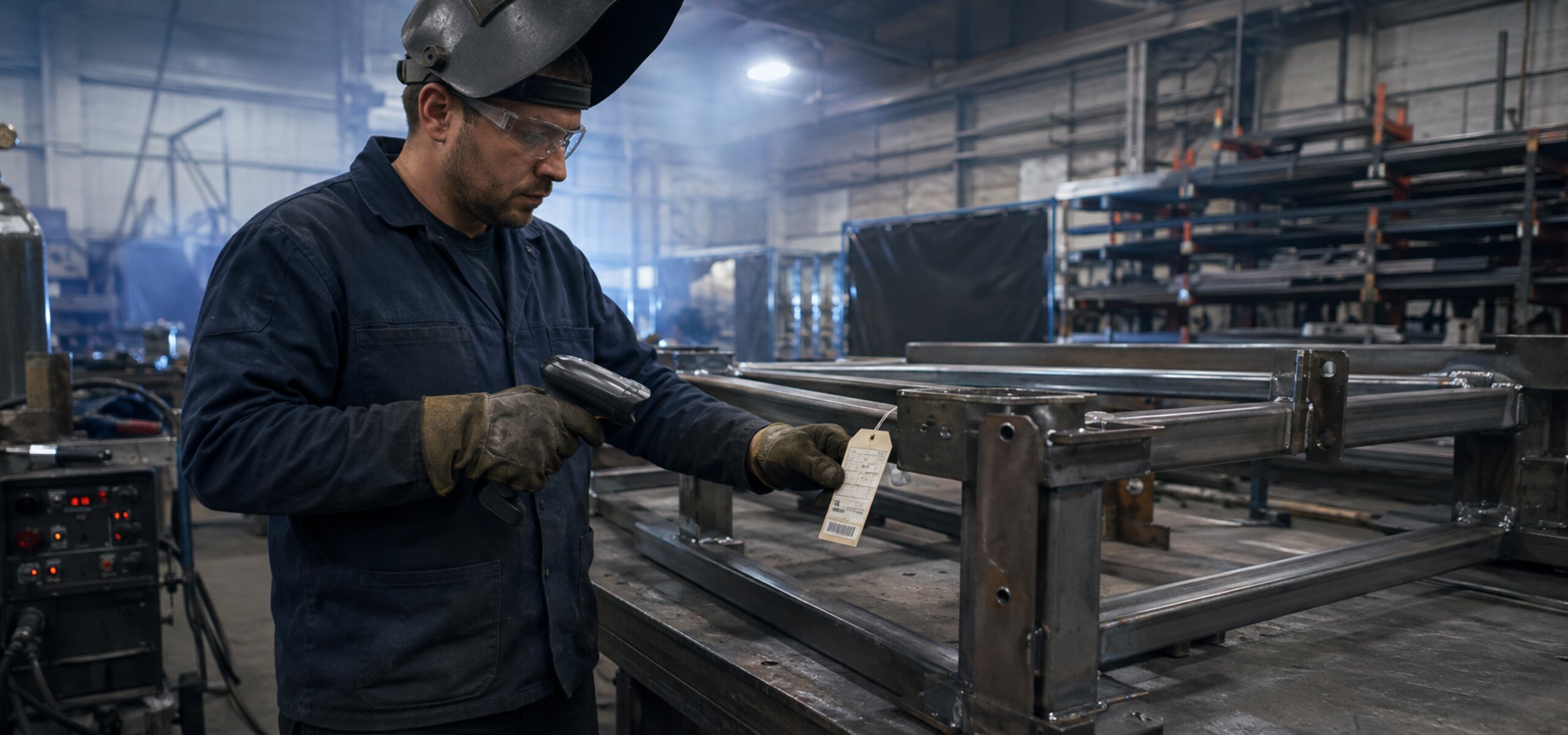
BellHawk is metal fabrication traceability software built to track jobs, materials, and work-center activity from a single barcode and RFID scan data layer, wherever a job is running in the shop.
Job & Work Order Tracking
Track work orders through cutting, forming, welding, finishing, and shipment, so the shop floor and the office see the same status.
Material & Scrap Yield Tracking
Compare issued stock against finished parts by job and material to see real yield, not the estimate from the quote.
Work-Center & Labor Tracking
Capture time, output, and operator at each work center to identify bottlenecks and support accurate job costing.
Barcode & RFID Tracking
Scan materials, jobs, and work orders to automate data capture, cut manual entry, and keep every system that depends on it accurate.
From raw stock to job record
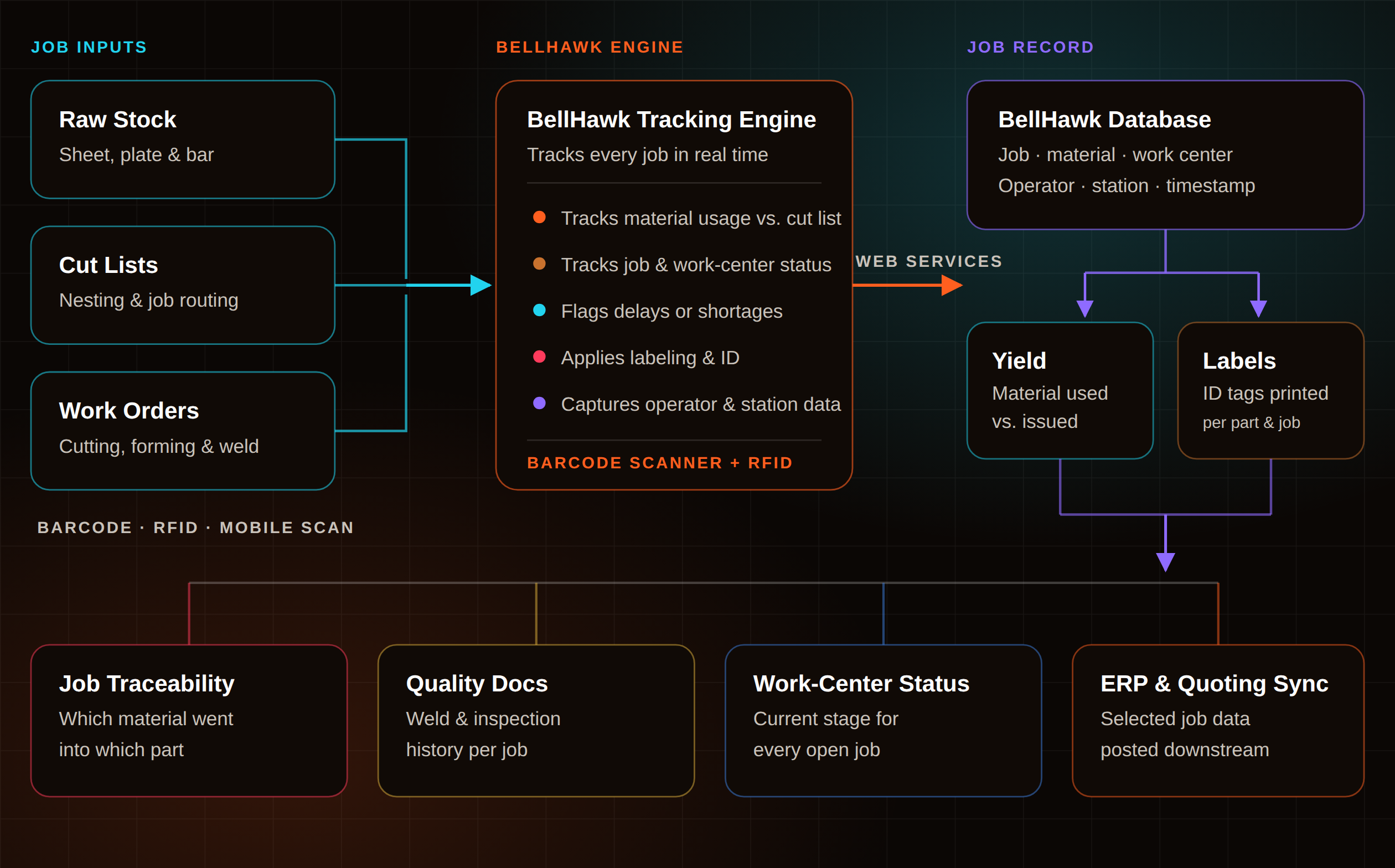
Raw stock, cut lists, and work orders are scanned by barcode and RFID at receiving and every work center as a job moves through the shop. BellHawk records material usage against the cut list, tracks job progress across cutting, forming, welding, and finishing, and applies labeling and identification at the part and job level. That record feeds the data MilramX uses to trigger rules-based alerts on delays or material shortages, consolidate visibility for shop and operations leadership, and synchronize selected data with ERP, quoting, and scheduling systems.
- Barcode and RFID capture at receiving and every work center.
- Material usage tracked against the cut list to reveal real yield.
- Job and work-center status updated in real time as parts move.
- Rules-based alerts flag delays, shortages, or missed process steps.
- Offline store-and-forward capture keeps the floor moving without a live connection.
- Selected data synchronized to ERP, quoting, and scheduling systems via MilramX.
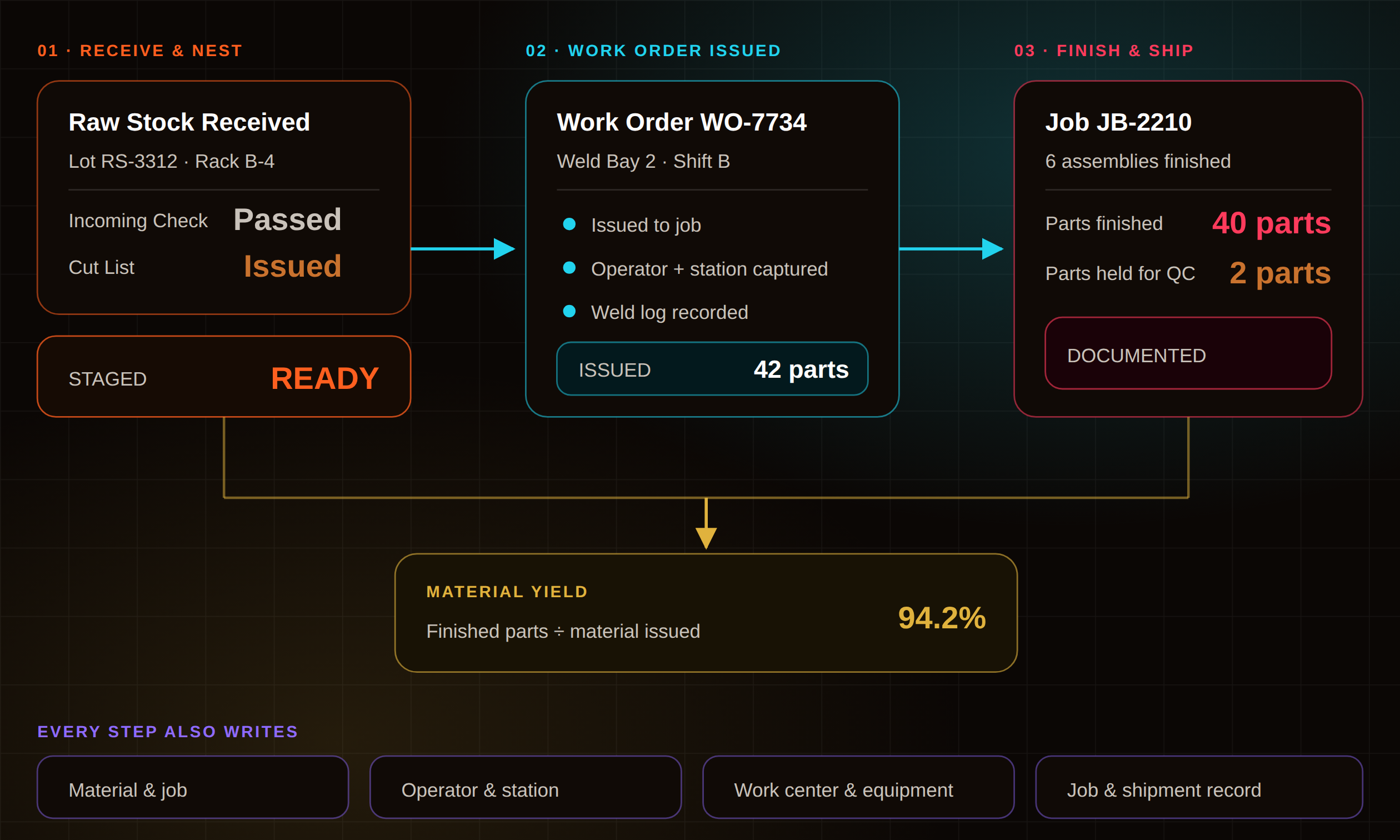
What happens to a job as it moves through the shop
Each of these stages is a real sequence a BellHawk-enabled fab shop follows, and each one writes something to the job record — so material and job status stay tracked end-to-end, work-center progress stays current, and quality documentation happens automatically instead of by hand.
Receive & Nest
Raw stock is scanned on arrival, and a cut list is issued to the job before material moves to the first work center.
Fabricate & Weld
Parts move through cutting, forming, and welding, with work-center time, output, and weld data captured at each step.
Finish & Ship
Finished parts are deburred or coated, inspected, labeled, and shipped, with the job record closing out with a full material and quality history.
Deployment flexibility for metal fabrication shops
KnarrTek's platforms adapt to how a fab shop actually runs, supporting minimal disruption during implementation and long-term scalability as job volume or shop floor space grows.
On-Premise Deployment
BellHawk and MilramX install fully in-house on existing infrastructure, providing complete data sovereignty — well suited to shops with strict IT policies or proprietary part designs.
Offline & Store-and-Forward
Rugged mobile devices buffer barcode and RFID scans locally in metal-shielded or connectivity-challenged areas of the shop floor and synchronize automatically once reconnected.
Hybrid Cloud
Data capture stays on secure local servers while cloud-based analytics give shop leadership consolidated job and material metrics across one or multiple facilities.
Where MilramX extends BellHawk with automation
MilramX is the half of KnarrTek's metal fabrication workflow solutions that turns BellHawk's real-time scan data into action — automating workflows and synchronizing information across ERP, quoting, and scheduling systems, reducing manual effort and supporting consistent job costing and quality documentation.
Rules-Based Alerts & Automation
Configure automated alerts for material shortages, delayed jobs, or missed work-center steps, and standardize routing across jobs to reduce reliance on manual oversight.
Data Visibility for Leadership
Consolidate data from multiple work centers into one view of job progress, material yield, and labor utilization to support planning and quoting.
ERP & Quoting Integration
Sync BellHawk data with ERP, quoting, and scheduling software to reduce duplicate entry and keep job costing aligned with what actually happened on the floor.
Why metal fabrication shops choose KnarrTek
KnarrTek's metal fabrication traceability and workflow solutions tackle the core pain points of job-shop work: untracked material yield, manual paper travelers, slow bottleneck detection, and documentation assembled by hand.
Real-Time Job Visibility
Instant insight into job status and work-center progress replaces phone calls and walks to the shop floor.
Reduced Material Waste
Tracking real usage against the cut list surfaces scrap and drop trends before they quietly erode job margin.
Fewer Manual Errors
Barcode and RFID capture replaces paper travelers, cutting the transcription errors that come with manual job tracking.
Faster Quality Documentation
Weld logs, material records, and inspection results are assembled from the job record instead of pieced together by hand.
Better Work-Center Coordination
Shared, real-time data helps cutting, forming, welding, and finishing stay in sync instead of working from separate boards.
Scalable Across Jobs
Modular deployment adapts from a handful of jobs a week to a high-mix, multi-work-center shop without a system overhaul.
Two ways metal fabrication traceability solutions are deployed
BellHawk and MilramX support a range of shop configurations. These are representative patterns rather than a specific fabricator's results, described so you can recognize which one resembles your own operation.
Many small custom jobs tracked from quote to shipment
Every job gets a barcode at kickoff, and each work-center scan updates its status — so a shop running dozens of concurrent small jobs always knows where each one actually is.
A job shop running a high mix of small, custom orders issues a barcode or RFID tag to each job at kickoff. BellHawk records material issued against the job's cut list and updates status as the job moves through cutting, forming, welding, and finishing, so the office can quote and schedule new work without losing track of what's already in progress.
Accurate job status without shop-floor phone calls, material yield visibility on jobs quoted thin, and a documented history ready when a customer asks for it.
Cutting, forming, welding, and finishing kept in sync
Each work center scans a job in and out, so a bottleneck at welding is visible to the whole shop the moment it happens, not at the next production meeting.
A larger fab shop with dedicated cutting, forming, welding, and finishing areas uses BellHawk to scan a job in and out of each work center, capturing time, operator, and output at every step. MilramX consolidates that data into a shop-wide view, flagging a bottleneck at any one work center before it delays every job behind it.
Earlier visibility into work-center bottlenecks, more accurate labor and job costing, and less time spent reconciling separate paper travelers between departments.
These are representative application patterns, not guaranteed outcomes. Actual results depend on shop layout, equipment and network conditions, process design, implementation scope, data quality, integrations, procedures, training, and user adoption.
Three ways to run metal fabrication workflow software
BellHawk and MilramX are the metal fabrication traceability software underneath KnarrTek's product line, delivered as three packaged options. Which one fits depends on how much of your shop runs through the system, how you need to deploy it, and how much automation you want around exceptions.
BellHawk Online
Browser-based real-time tracking for materials, jobs, barcode scans, and work-center activity, without replacing your ERP or quoting platform. Material receipts, job status, and shipments are visible the moment they're scanned, with no local server to maintain.
WIPtracker
In-shop MES and WMS control covering job and work order tracking, material and scrap yield, work-center labor capture, and barcode and RFID data — the deeper on-site foundation fabricators use for full cut-to-ship traceability.
SmartOps24x7
ERP and quoting integration built around KnarrTek's MilramX agents, adding rules-based alerts, 24/7 system oversight, and automated data exchange across connected shop management systems.
Job traceability is one part of a larger record
BellHawk's metal fabrication traceability software works alongside the other ways KnarrTek collects data at the point of work. Most deployments combine two or three of these.
Real-Time WIP Tracking
Work-in-process visibility across every work center, so a job's status is always current wherever it sits in the shop.
WIP trackingInventory & Asset Tracking
Accurate material and equipment visibility across the shop, the record that every job transaction posts into.
Inventory trackingRFID Tracking Software
KnarrTek's RFID tracking software delivers hands-free identification that streamlines and automates job and material tracking where barcode scanning alone is impractical.
RFID trackingTrack & Trace Materials
Traceability software for material genealogy from receiving to shipment, linking every raw stock lot to the job it became.
Materials traceabilityMaterials Flow & Job Tracking
Movement and job progress monitored throughout the shop, giving work-center transactions their operational context.
Job trackingCommon questions about job traceability and shop-floor control
Practical answers about KnarrTek's metal fabrication traceability and workflow solutions — BellHawk, MilramX, RFID, and what actually gets tracked once a job hits the shop floor.
What is metal fabrication traceability software?
Can this track material yield and scrap by job?
Does this replace our paper travelers or job boards?
Can this capture weld logs and work-center data?
Do we have to choose between barcode and RFID?
Can this run in shops with limited connectivity or metal shielding?
What's the difference between BellHawk and MilramX?
Can this integrate with our ERP or quoting software?
How does this help with work-center bottlenecks?
Does this support quality and material certification documentation?
Can this scale from a small shop to a multi-work-center facility?
What does implementation typically involve?
Ready to see every job from cut to ship?
Start with the visibility gap costing you the most material or margin — KnarrTek's metal fabrication workflow solutions team can help map your jobs, materials, work centers, and integrations needed to turn barcode and RFID scans into a complete job record, on-premise, offline, or hybrid.
