
Automotive Traceability Solutions for Real-Time Manufacturing Visibility
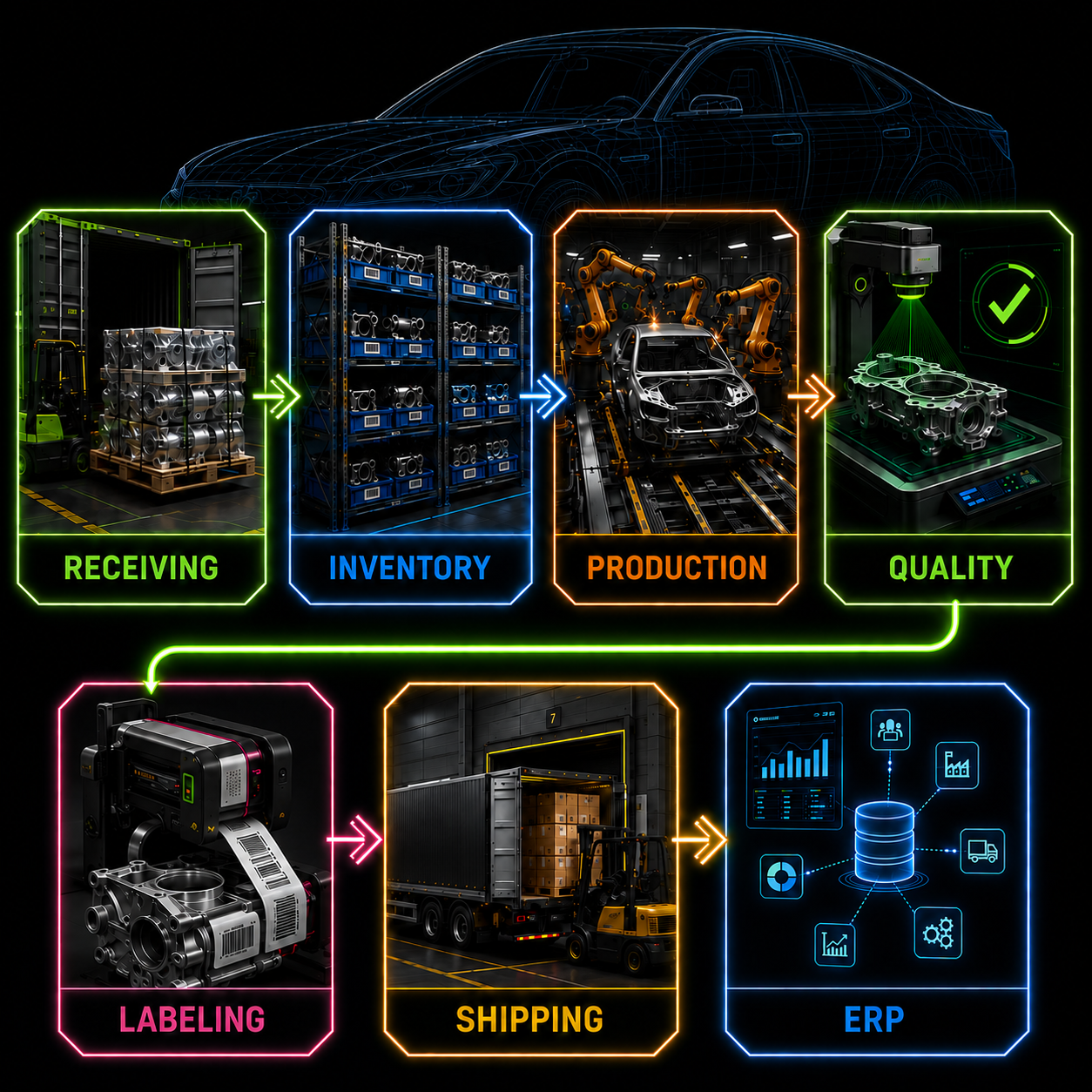
Automotive traceability from KnarrTek connects materials, inventory, work-in-process, production, quality, labeling, part genealogy, shipping, and ERP activity in real time. This automotive manufacturing software helps OEM suppliers and Tier 1, Tier 2, and Tier 3 operations capture critical activity where the work happens, keep teams aligned, and build a dependable production history.
What is automotive traceability software?
Automotive traceability software creates a connected digital history of materials, components, work orders, production steps, inspections, labels, containers, and shipments. Automotive parts traceability helps a manufacturer answer what was received, where it moved, which job used it, who performed the work, what quality decision was made, and which customer shipment received the finished part.
Material Genealogy
Connect supplier records, heat numbers, lot numbers, serial numbers, containers, and material consumption to the finished component.
Live WIP Status
See which work orders are active, waiting, held, complete, staged, or delayed without rebuilding the story from paper travelers.
Quality Control
Connect inspection status, nonconformance, rework, approvals, and release decisions to the materials and parts they affect.
Shipment Validation
Verify parts, containers, customer orders, labels, and shipping activity before automotive components leave the facility.
Capture the plant-floor activity your ERP may not see as it happens.
Automotive companies often depend on ERP or MRP systems for planning, purchasing, customer orders, and financial control. The visibility gap appears between those business transactions. Materials are received, split, moved, staged, consumed, inspected, reworked, packed, and shipped before every detail reaches the ERP.
KnarrTek’s automotive manufacturing software helps close that gap. Automotive traceability captures transactions through barcode scanners, RFID tracking, rugged mobile devices, shared workstations, labels, scales, and connected equipment. Selected operational data can then be validated, transformed, reported, or exchanged with ERP and other business systems.
- Capture: record receiving, movement, production, inspection, labeling, and shipping activity.
- Connect: link parts, lots, serial numbers, jobs, people, machines, containers, and customers.
- Control: apply workflow rules, status validation, alerts, permissions, and exception handling.
- Communicate: share accurate updates with managers, quality teams, customers, and connected systems.
Control the handoffs where production data is most likely to break down.
High product variation, just-in-time schedules, customer-specific labels, complex supplier networks, and strict quality expectations create risk whenever information is delayed or disconnected. Automotive traceability helps teams capture the details needed to respond before an exception becomes a missed shipment, quality escape, or time-consuming investigation.
Unclear Material Availability
Record receiving, putaway, transfers, allocations, staging, and consumption so teams can see what is actually available for production.
Delayed Job Updates
Capture production status, labor, machine time, quantities, scrap, and route progress at the point of work instead of after the shift.
Incomplete Part Genealogy
Link raw-material lots and component serial numbers to batches, subassemblies, finished parts, containers, and outbound shipments.
Quality Holds and Rework
Make quality status visible, restrict the use or shipment of unapproved material, and maintain connected inspection and rework records.
Label and Shipping Errors
Validate the part, quantity, container, customer order, label, and shipment before product is staged or loaded for delivery.
Disconnected Systems
Exchange selected operational data with ERP, MRP, accounting, EDI, shipping, reporting, and customer-facing systems.
Automotive traceability built around real operational transactions.
KnarrTek automotive manufacturing software can be configured around the materials, identifiers, routes, quality states, labels, devices, and reports used in your facility. Each physical movement and production event becomes part of a reliable, searchable automotive traceability record.
Inventory Tracking
- Raw materials and purchased parts
- Bins, racks, lines, and staging zones
- Reusable containers and returnables
Real-Time WIP Tracking
- Work order and route status
- Quantities, scrap, and rework
- Labor and machine activity
Lot & Serial Traceability
- Supplier-to-customer genealogy
- Lot, batch, heat, and serial records
- Forward and backward trace searches
Barcode & RFID Tracking
- Part and container identification
- Handheld, fixed, and portal reads
- Hybrid confirmation workflows
Quality Records
- Inspection, hold, and release status
- Nonconformance and rework history
- Audit-ready transaction records
Labels & Shipping
- Part, box, tote, pallet, and shipment labels
- Pick, pack, stage, and ship validation
- Customer-specific data and workflows
Automation & Integration
- ERP-connected data exchange
- Rules, alerts, and exception monitoring
- Reports and system updates
Operational Reporting
- Job, labor, material, and machine activity
- Inventory and shipment visibility
- Exception and traceability reporting
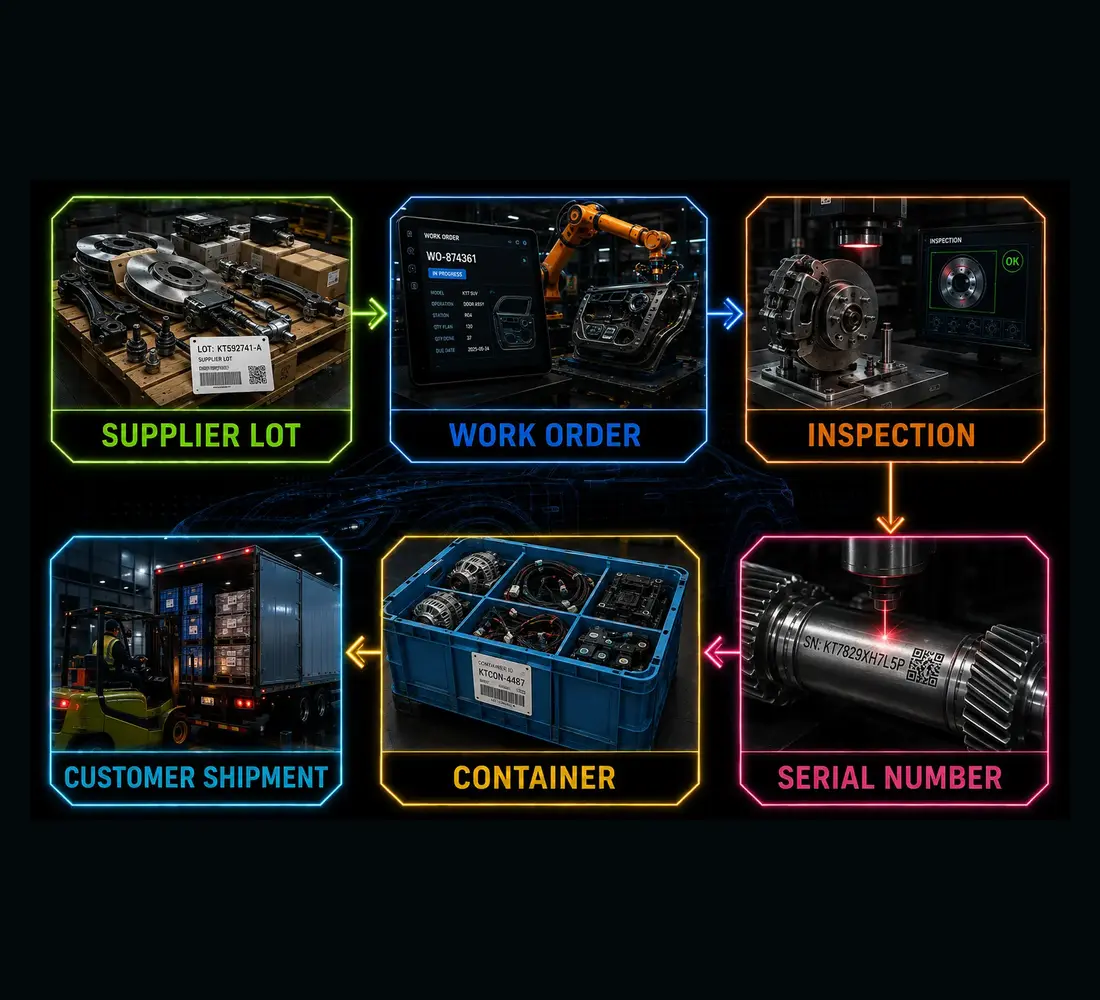
How automotive traceability follows every production handoff.
Automotive traceability becomes useful when it connects each handoff. KnarrTek supports a continuous operational history across warehouse, real-time WIP tracking, production, quality, packaging, shipping, and connected business processes.
Receive
Capture supplier, purchase order, item, quantity, lot, serial, and container data.
Store
Track putaway, location, movement, status, availability, and controlled inventory.
Produce
Connect material use, labor, equipment, route steps, output, scrap, and rework.
Inspect
Record checks, results, approvals, holds, nonconformance, and release decisions.
Label
Identify parts, boxes, totes, pallets, lots, serials, and customer shipments.
Ship
Validate picks, containers, orders, staging, loading, shipment, and system updates.
Give each team the view it needs without creating separate versions of the truth.
Automotive traceability gives operations leaders current WIP and production status, while quality teams receive connected inspection, hold, rework, and release history. Warehouse teams gain accurate locations, containers, lots, and availability. IT teams gain controlled interfaces and dependable monitoring. Customer service receives reliable order and shipment answers.
- Plant managers: see work status, bottlenecks, material risk, and shipping readiness.
- Quality leaders: connect inspection and disposition decisions to actual parts and lots.
- Warehouse teams: capture receiving, movement, replenishment, staging, and shipment activity.
- IT and ERP teams: exchange selected data without forcing the ERP to become a shop-floor system.
- Customer-facing teams: answer traceability and delivery questions using connected records.
Automotive traceability case studies from component manufacturing.
These anonymized application studies illustrate how automotive traceability and automotive manufacturing software support real manufacturing workflows. They are presented as historical examples, not as claims about a customer’s current system, performance, or relationship with KnarrTek.
End-to-end automotive parts traceability for precision rubber components
A three-shift, seven-day operation needed to trace specialty rubber from receipt through molding, inspection, packing, and delivery to automotive plants.
- Tracked receipt, putaway, machine issue, molded batches, quality inspection, boxed parts, and shipments
- Used barcoded tracking cards, scanners, mobile computers, and controlled customer-plant shipments
- Exchanged purchase order, production, consumption, inventory, and shipment data with the manufacturer’s business system
The connected automotive traceability and quality-status record helped the manufacturer demonstrate that defective batches were not shipped and that reworked batches were tested before release.
Discuss a Similar WorkflowWIP, cost, labor, machine, and lot visibility across a 24/7 plant
A precision component manufacturer serving safety, medical, and automotive customers needed better visibility into hundreds of active jobs and multi-step production routes.
- Tracked WIP location, order status, raw-material lots, employees, machines, coating data, labor, and material use
- Received jobs, routes, and bills of material from the company’s planning system through an automated interface
- Returned material cost, labor hours, and machine hours for planned-versus-actual job costing
The workflow created a more complete automotive traceability and costing record while reducing reliance on manual reconstruction of WIP status.
Discuss a Similar WorkflowCustomer names are not disclosed in the published source material. Results depend on workflow design, implementation scope, data quality, integrations, devices, and user adoption.
Support ISO 9001 and IATF 16949-oriented recordkeeping with controlled operational data.
Software does not certify a facility or guarantee compliance. Automotive traceability can help organizations maintain the structured material, production, quality, user, label, and shipment records that support internal controls, customer requirements, audits, investigations, and continuous-improvement programs.
Traceable Inputs
Connect suppliers, purchase orders, certificates, item records, lots, heat numbers, serials, and receiving inspections.
Controlled Status
Make hold, inspection, release, nonconformance, rework, and disposition status visible to authorized users.
Production History
Preserve work order, route, operator, equipment, material-use, output, scrap, and process-event records.
Shipment Evidence
Connect finished parts, labels, containers, customer orders, picks, packing, staging, and shipping confirmation.
Start with the deployment and operational depth your automotive facility needs.
KnarrTek offers cloud, on-premise, and connected automotive manufacturing software for different levels of automotive traceability, inventory tracking, production control, WIP visibility, automation, integration, and monitoring.
BellHawk Online
Browser-based inventory, production, labor, material, barcode, asset, and job-activity tracking for teams that want practical visibility without a large IT project.
WIPtracker
MES and WMS workflows for WIP, warehouse control, materials traceability, quality, labeling, job costing, barcode, RFID, and shop-floor operations.
SmartOps24x7
Rules-based automation, alerts, data exchange, ERP integration, transformation, reporting, and monitoring for complex software environments.
Adaptable for automotive OEMs, suppliers, and component manufacturers.
Automotive traceability supports make-to-stock, make-to-order, engineer-to-order, repetitive, discrete, batch, and hybrid operations. KnarrTek workflows can be tailored around the identifiers, controls, devices, and customer requirements used by each automotive business.
Stamped & Machined Parts
Track coils, sheets, bars, heat numbers, work orders, machines, inspections, containers, and finished parts.
Plastics & Rubber
Connect compound lots, molding batches, tools, process steps, quality status, packing, and shipment history.
Electronics & Sensors
Maintain component-lot, serialized-unit, assembly, test, rework, label, and customer-shipment traceability.
EV & Battery Components
Track controlled materials, lots, serials, work orders, inspections, subassemblies, finished units, and containers.
Interiors & Trim
Monitor materials, kits, color or style variants, production status, quality decisions, labeling, and sequencing.
Powertrain Components
Connect material genealogy, machining, treatment, assembly, inspection, serial records, packing, and shipment.
Tier Suppliers
Coordinate customer-specific requirements, incoming materials, production schedules, labels, traceability, and delivery.
Aftermarket Parts
Improve inventory, lot and serial visibility, kitting, picking, labeling, packing, and order-fulfillment records.
Explore the tracking capabilities behind the automotive workflow.
Review KnarrTek capability pages covering automotive traceability, real-time WIP tracking, inventory control, RFID tracking, material genealogy, barcode capture, and job tracking in greater technical detail.
Manufacturing Tracking
Connect work orders, WIP, inventory, raw materials, labor, lots, labels, quality, and shipments.
Explore CapabilitiesReal-Time WIP Tracking
Track job location, status, materials, labor, route progress, holds, scrap, rework, and completions.
View WIP TrackingInventory & Asset Tracking
Improve visibility across receiving, putaway, locations, containers, transfers, staging, picking, and shipping.
View Inventory TrackingRFID Tracking
Use contactless reads for faster material, container, pallet, asset, and high-volume movement capture.
View RFID TrackingMaterials Traceability
Connect lots, serial numbers, source materials, jobs, quality checks, labels, containers, and shipments.
View Track & TraceMaterials Flow & Job Tracking
Monitor job progress, labor, production steps, material usage, WIP movement, and delivery status.
View Job TrackingAnswers for automotive manufacturing, quality, warehouse, and IT teams.
These direct answers help automotive buyers compare automotive traceability, automotive manufacturing software, automotive parts traceability, real-time WIP tracking, RFID tracking, quality, labeling, and ERP integration options.
What does automotive manufacturing software track?
How does automotive parts traceability work?
Can KnarrTek integrate with an automotive manufacturer’s ERP?
Does KnarrTek replace the ERP?
Does KnarrTek support barcode and RFID tracking?
Can KnarrTek help with ISO 9001 or IATF 16949 requirements?
Can KnarrTek track reusable containers and returnable packaging?
Can the software run in cloud, on-premise, or connected environments?
Which automotive manufacturers are a good fit for KnarrTek?
Can KnarrTek support customer-specific labels, EDI, or shipment data?
How quickly can teams search lot or serial history?
Can KnarrTek track labor, machine time, and material usage together?
Can WIPtracker continue operating when internet connectivity is limited?
How does an automotive implementation begin?
Build automotive traceability around your real manufacturing workflow.
Start with the operational problem. KnarrTek can help map the transactions, identifiers, devices, users, labels, reports, alerts, and integrations needed to turn automotive traceability into a practical path from delayed information to real-time control.
