
Inventory Collateral Control for Commercial Lenders
Inventory Collateral Tracking for Banks and Commercial Lenders
KnarrTek helps banks, commercial finance companies, private credit lenders, and other commercial lenders maintain a clearer record of the physical inventory securing a business loan. Connect the inventory a borrower provides with actual quantities, warehouse locations, lots, pallets, containers, movements, inventory status, verification results, and lender-defined collateral requirements for that specific customer and loan.
- Customer and loan-specific records
- Physical inventory verification
- Real-time collateral exceptions
Physical collateral. Better lender visibility.
Know what inventory is supporting the loan, where it is, and what changed.
When a business uses inventory as collateral for a loan, that collateral can change every day. Materials are received, consumed in production, moved between warehouses, sold, shipped, returned, damaged, placed on hold, or written off. A lender may receive periodic inventory information from the borrower, but a summary total does not always explain the physical activity behind that number.
KnarrTek inventory collateral tracking creates a more detailed operational record for the inventory supporting a specific customer and loan. Authorized lender personnel can review what inventory exists, where it is located, when it moved, whether it was physically checked, what condition or status it is in, and whether anything has changed that may require additional review.
KnarrTek does not replace the lender's loan-management system and does not make credit, valuation, or legal decisions. It provides physical inventory visibility and traceable supporting evidence that can strengthen the lender's existing collateral review process.
Inventory collateral monitoring
Track the physical inventory securing each customer loan.
KnarrTek can organize collateral inventory by customer, loan, warehouse, item, lot, pallet, container, quantity, condition, and current status. This gives lenders a clearer connection between borrower-provided inventory information and the physical assets supporting the loan.
Raw Materials
Track purchased materials by quantity, receipt date, supplier, lot, storage location, and current status. This can help the lender understand whether reported raw material inventory is still present and where it is being held.
Work-in-Process
Follow inventory that has entered production but is not yet a finished product. The record can show how materials were issued, where the work is located, and whether quantities changed during production.
Finished Goods
See completed inventory that is available, allocated, awaiting shipment, returned, placed on hold, or otherwise being held by the borrower.
Warehouses & Locations
Identify which plant, warehouse, third-party facility, rack, bin, staging area, or other location physically holds the inventory associated with the loan.
Lots, Pallets & Containers
Track inventory in greater detail with lot numbers, serial numbers, pallet IDs, container numbers, reels, totes, boxes, or other physical identifiers.
Inventory Condition & Status
Distinguish normal available inventory from damaged, aging, quarantined, obsolete, customer-owned, consigned, returned, restricted, or otherwise questionable stock.
Inventory Movement
Record when inventory is received, transferred, used in production, adjusted, returned, disposed of, sold, packed, or shipped so changes are easier to explain.
Supporting Evidence
Connect inventory with count results, receiving information, transaction history, approved valuation references, notes, documents, and other records used during collateral review.
Inventory collateral tracking in action
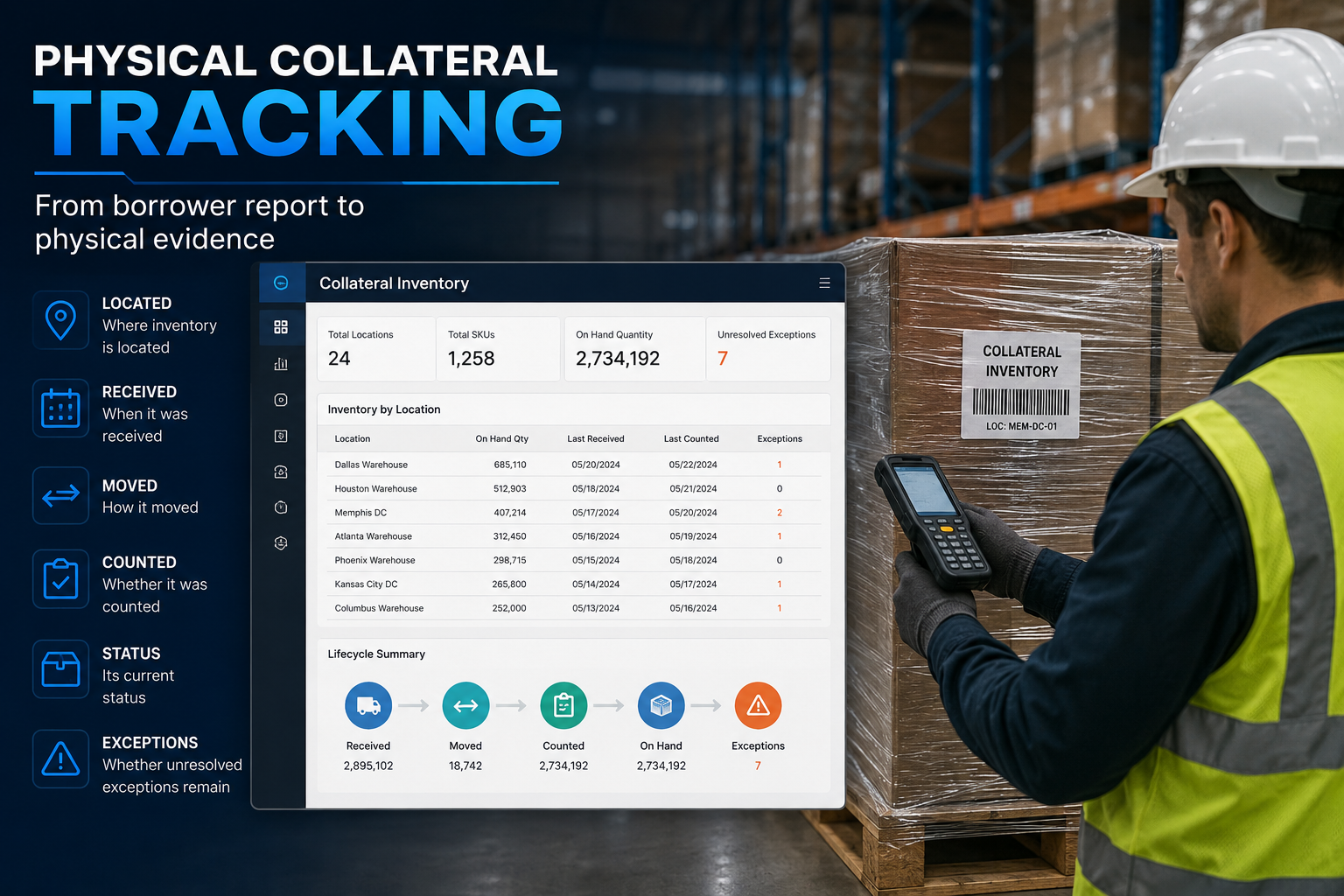
Connect borrower-provided collateral information with the inventory that physically exists.
A borrower may identify hundreds of thousands or millions of dollars of inventory as collateral. KnarrTek can connect that inventory with the actual items, quantities, lots, pallets, containers, storage locations, status, and transaction history behind the total.
Lenders can use this information when reviewing a customer's collateral, investigating differences, deciding what inventory requires additional verification, or evaluating changes in the physical assets supporting a particular loan.
- Customer and loan visibility
- Reported versus verified inventory
- Inventory location and status
- Current collateral exceptions
Loan collateral review
Give the lender better evidence behind the inventory assigned to a loan.
Each lender decides which inventory it will recognize as collateral and how that inventory is treated for lending purposes. KnarrTek does not make that determination. The system helps the lender organize, verify, and preserve the physical inventory information used in its own review.
For example, a lender may want to distinguish normal available finished goods from damaged inventory, stock stored at an unexpected location, inventory that has aged beyond an internal limit, or inventory the borrower does not own. KnarrTek can apply lender-provided classifications and make those records easier to identify.
Receive
Associate inventory information with the correct customer and loan using borrower-provided records or approved connected data.
Verify
Compare reported quantities with physical counts, warehouse records, recent movements, and other available evidence.
Classify
Apply the lender's own categories so normal, restricted, aging, damaged, excluded, or review-required inventory is easy to identify.
Review
Review differences between what the borrower provided and what the physical or operational inventory records show.
Document
Preserve findings, explanations, approvals, dates, users, and supporting history for the specific customer and loan.
Lender-defined requirements
KnarrTek provides the inventory evidence. The lender controls the lending rules.
- The lender determines which inventory it recognizes as acceptable collateral.
- The lender determines valuation methods, lending limits, reserves, and other credit requirements.
- KnarrTek can apply lender-provided categories, limits, rules, and review requirements to inventory records.
- Credit approval, lien status, legal requirements, valuation decisions, and loan terms remain with the lender and its authorized specialists.
Follow collateral as inventory moves
See what happens to inventory after the borrower provides it as collateral.
Inventory does not remain in one place. It may move from receiving to storage, into production, between facilities, into finished goods, and ultimately to a customer. Those movements can change the quantity, location, condition, or status of inventory associated with the loan.
Barcode, RFID, mobile, and system-connected workflows can create a transaction history showing what moved, where it went, when the movement occurred, and what happened next. The lender can use that history to investigate a difference instead of relying only on a beginning balance and an ending total.
- Receiving to warehouse
- Warehouse to production
- Raw material to finished goods
- Warehouse-to-warehouse transfer
- Inventory to customer shipment
- Returns, disposal, or write-offs
Targeted inventory checks
Verify selected collateral without recounting an entire warehouse.
A lender may not need to physically verify every item each time a borrower provides updated inventory information. KnarrTek can help organize targeted checks based on value, age, location, previous differences, unusual activity, or other lender-defined criteria.
For example, a lender could request verification of high-value inventory, older stock, a particular warehouse, selected pallets, or inventory that recently experienced a large adjustment. The verification result remains attached to the appropriate customer and loan.
Select the Inventory
Choose the warehouse, products, lots, pallets, containers, or categories that should be checked.
Verify What Is There
Confirm physical quantities, locations, identifiers, condition, and current inventory status.
Review Differences
Use receiving, movement, production, adjustment, transfer, and shipping history to help explain a discrepancy.
Record the Result
Preserve what was checked, who performed the verification, what was found, and what follow-up is still required.
Physical inventory verification as a service
KnarrTek can verify the borrower's physical inventory for the lender.
KnarrTek can provide physical inventory verification as a service when a lender needs an independent operational check of inventory associated with a customer loan. KnarrTek personnel can visit an authorized borrower warehouse, manufacturing facility, distribution center, or other approved location and verify selected inventory against the records provided for the review.
The lender can define the customer, loan, facility, inventory categories, products, locations, lots, pallets, containers, or other inventory that should be checked. KnarrTek can then perform the physical verification, document what was observed, compare the results with the expected inventory information, and preserve the findings for lender review.
This service gives lenders another way to confirm that inventory is physically present without requiring the lender's own personnel to perform every count. The resulting record can also be connected with KnarrTek inventory history when the borrower is using KnarrTek tracking technology.
Define the Verification
Identify the customer, loan, borrower locations, inventory categories, products, lots, containers, and other inventory that should be checked.
Visit the Facility
KnarrTek personnel can perform the authorized verification at the warehouse, plant, distribution center, or other location where the inventory is stored.
Count Physical Inventory
Verify selected raw materials, work-in-process, finished goods, pallets, lots, containers, serialized products, or other identified inventory.
Compare Expected and Actual
Compare the inventory information provided for the review with what is physically observed at the borrower location.
Document Differences
Record missing inventory, quantity differences, unexpected locations, condition issues, identification conflicts, or other findings requiring lender attention.
Provide the Verification Record
Preserve a dated record showing what was checked, what was found, who participated, the differences identified, and any required follow-up.
Physical verification, not a credit decision
KnarrTek documents the inventory. The lender determines what the findings mean for the loan.
- KnarrTek can physically count and verify inventory selected by the lender.
- Verification can document quantity, identity, location, condition, and observable inventory status.
- Findings can be compared with the inventory information supplied for the customer and loan.
- The lender remains responsible for valuation, collateral eligibility, legal conclusions, lending decisions, and any formal financial or audit determination.
Collateral risk and exception monitoring
Identify changes in borrower inventory that may deserve lender attention.
KnarrTek can evaluate inventory activity for conditions that do not match expectations. Authorized lender personnel can be alerted when a significant change or discrepancy occurs in inventory associated with a specific customer and loan, helping the lender investigate while the supporting activity is still easy to trace.
Borrower-provided quantities do not match recently verified inventory.
Inventory has been moved to an unexpected or unapproved location.
Large or unusual manual inventory adjustments have occurred.
Inventory has remained unsold or unused longer than a lender-defined limit.
Damaged, quarantined, obsolete, or restricted inventory appears in collateral records.
Duplicate pallet, container, lot, or inventory identifiers appear in the records.
Inventory was transferred, consumed, adjusted, or shipped without the expected supporting record.
The same location or inventory category repeatedly produces unexplained differences.
An inventory exception does not automatically mean fraud, default, or loss of collateral value. It identifies information that the lender may want to review more closely.
Customer and loan collateral records
Keep each customer's inventory evidence tied to the correct loan.
KnarrTek organizes collateral information on a customer-by-customer and loan-by-loan basis. Authorized users can review the record for a specific lending relationship and see the associated inventory, verification history, open exceptions, supporting activity, and unresolved follow-up without depending on a portfolio-wide dashboard.
Current Inventory
- Inventory by warehouse, item, lot, pallet, and container
- Current quantity, location, condition, and status
- Raw material, work-in-process, and finished-goods records
Borrower-Provided Inventory
- Inventory information associated with the specific customer and loan
- Borrower-provided quantities compared with verification results
- Differences requiring explanation or additional review
Collateral Status
- Lender-defined collateral categories attached to inventory records
- Inventory identified as normal, restricted, excluded, or review required
- Supporting notes and approval history for collateral classifications
Open Exceptions
- Unexplained inventory differences
- Unexpected location, age, condition, or status changes
- Outstanding explanations, approvals, or corrective actions
Verification History
- Previous physical inventory checks for the customer
- Who performed each verification and when
- Differences, explanations, approvals, and resolution history
Inventory Activity History
- Receiving, movement, production, adjustment, transfer, and shipping activity
- Changes affecting the quantity or status of collateral inventory
- Traceable supporting records for later lender review

From borrower information to physical evidence
Give collateral analysts more than a spreadsheet total.
Inventory collateral tracking can connect borrower-provided quantities with the operational activity behind those quantities. Authorized lender personnel can review where inventory is located, when it was received, how it moved, whether it was physically checked, its current condition and status, and whether unresolved differences remain.
A record that says a borrower has 25,000 units of a product becomes more useful when the lender can identify the lots, pallets, containers, locations, and recent transactions behind that total. KnarrTek can use barcode labels, RFID, item numbers, lot numbers, serial numbers, pallet IDs, container identifiers, and warehouse locations to create that more detailed record.
This creates a clearer connection between information supplied by the borrower and the physical inventory supporting the specific lending relationship.
Connect approved inventory data
Use borrower and lender system data when a connection is useful.
KnarrTek can work with information entered directly into the collateral-tracking workflow or receive approved data from existing systems. A connection can reduce repeated manual entry when the lender and borrower want inventory quantities, locations, movements, customer information, or loan identifiers to flow into the correct collateral record.
The purpose of the connection is simple: keep the physical inventory record aligned with the systems already used by the borrower and lender. KnarrTek does not require replacement of the borrower's ERP, warehouse software, accounting system, or the lender's loan-management platform.
Inventory & Warehouse Data
Receive approved quantities, locations, lots, containers, movements, or inventory status from supported ERP, warehouse, manufacturing, barcode, RFID, or accounting systems.
Customer & Loan Information
Associate inventory with the correct customer, loan, lending facility, and lender-defined collateral requirements using approved information from lender systems.
Supported Connection Methods
Connections may use APIs, secure files, database views, event messages, middleware, or other supported methods depending on the systems and permissions involved.
Controlled data exchange
Connect only the information the lender and borrower approve.
- Each source system must provide a supported way to exchange the required information.
- The participating organizations determine which data, users, permissions, and systems are approved.
- Connections may be read-only or transaction-based depending on the approved workflow.
- Architecture, security, licensing, documentation, and testing are reviewed before an interface is confirmed.
Inventory collateral tracking FAQ
Frequently asked questions for banks and inventory-secured commercial lenders.
What is inventory collateral tracking?
Inventory collateral tracking creates a more detailed record of the physical inventory supporting a secured business loan. It can include quantities, locations, lots, pallets, containers, movements, condition, status, physical verification, and supporting history tied to the appropriate customer and loan.
Can KnarrTek compare borrower-provided information with physical inventory?
Yes. KnarrTek can preserve borrower-provided quantities alongside physical inventory information, verification results, transaction history, discrepancies, explanations, and follow-up activity for the specific customer and loan.
Can KnarrTek perform physical inventory verification for the lender?
Yes. KnarrTek can provide physical inventory verification as a service. KnarrTek personnel can visit authorized borrower locations, verify selected inventory, document quantities and observable inventory details, compare the findings with information provided for the review, and preserve the results for the lender.
Can KnarrTek identify aging, damaged, or restricted inventory?
Inventory records can include dates, condition, status, activity history, and lender-defined rules that help identify older, damaged, quarantined, obsolete, restricted, customer-owned, or otherwise questionable inventory for review.
Does KnarrTek decide whether inventory qualifies as loan collateral?
No. The lender establishes collateral requirements, valuation methods, lending limits, legal requirements, and credit decisions. KnarrTek provides tracking, verification, comparison, exception monitoring, and supporting records around those lender-defined requirements.
Can KnarrTek keep records separate for different customers and loans?
Yes. Inventory, verification results, exceptions, transaction history, notes, and supporting information can be associated with the appropriate customer and loan so one lending relationship can be reviewed independently from another.
Explore more
Build a stronger physical inventory control foundation.
Inventory & Asset Tracking
Track physical inventory, quantities, warehouse locations, containers, movements, and real-time inventory activity.
CapabilityBarcode Tracking
Connect physical items, lots, pallets, containers, locations, employees, and transactions with digital inventory records.
Technical ResourcesKnarrTek White Papers
Explore guidance on inventory accuracy, physical tracking, traceability, verification, error prevention, and connected operations.
Need better visibility into inventory-secured loans?
Show us how you currently monitor a customer's inventory collateral.
KnarrTek can help map the customer, loan, physical inventory, warehouse locations, verification requirements, lender-defined collateral rules, exceptions, alerts, supporting records, physical verification services, and approved system connections behind a more visible inventory-secured lending process.
Talk With KnarrTek