

Defense Traceability Solutions for Serialized Parts, CMMC, and ITAR Records
KnarrTek defense traceability solutions track serialized parts, secure equipment, and controlled materials by barcode and RFID from receipt through program issue and shipment, for defense contractors and their suppliers.
Every scan writes to one auditable record, so serial and lot genealogy, export-control markings, and supporting documentation are ready before a prime, program office, or assessor asks, whether your facility runs on-premises, on an isolated network, or hybrid.
- Serialized Parts Tracking
- Barcode and RFID
- Counterfeit Part Holds
- On-Premises Deployment
What Are Defense Traceability Solutions?
Defense traceability solutions combine manufacturing execution (MES) and warehouse management (WMS) functions to track serialized parts, secure equipment, and controlled materials by serial and lot number, from receipt through program issue and shipment. KnarrTek delivers them on two platforms: BellHawk, which captures barcode, RFID, and mobile scan data at every handling step, and MilramX, which adds rules-based automation and ERP and PLM integration on top of that data.
Automated Serial Capture
Scans record part, lot, and program data the moment material is handled, not from a log typed in later.
MES and WMS in One System
Production and warehouse share one database, so a part's genealogy and its stock movements are the same record.
Holds Before Issue
Configured checks hold non-conforming or suspect parts before they reach an assembly, with a trail behind every serial.
Controlled Deployment
Runs on-premises or on an isolated network, so controlled environments aren't forced onto a live cloud connection.
Where Defense Traceability Breaks Down Without the Right System
Most defense contractors already have quality procedures on paper. What's missing is a system fast enough to answer a program audit in real time, and connected enough that a spreadsheet edit in one department doesn't quietly go stale in another, without exposing controlled data to an unnecessary network connection.
Requirements still phasing in
The CMMC program sets the cybersecurity requirements DoD contractors must meet, and its assessment requirements are being phased into contracts over time. Records need to stay audit-ready as the stage changes.
Export-control markings that drift
The U.S. Munitions List and related exemptions are updated periodically. Every serialized part and shipment needs a marking tied to the record in force when it moves.
A recordkeeping baseline already in place
DFARS 252.204-7012 requires safeguarding covered defense information under NIST SP 800-171, the baseline CMMC Level 2 assessments are built on.
Gaps in counterfeit parts prevention
GAO reports (GAO-12-375, GAO-16-236) documented weaknesses in detecting counterfeit electronic parts in the defense supply chain, making serial-level provenance a genealogy problem.
Serial history scattered on paper
Paper logs and disconnected spreadsheets scatter the serial and lot history that audits and prime contractor flow-downs depend on.
Disconnected and controlled areas
Controlled-access facilities often can't run a continuously connected cloud system, but still need every scan captured.

What KnarrTek Defense Traceability Solutions Do
BellHawk is built for serialized-parts environments, combining manufacturing execution and warehouse management behind one barcode, RFID, and mobile scan layer.
Program managers, quality, receiving, and shipping all work from the same serial record instead of separate logs.
Serialized Parts Tracking
Serialized parts tracking by serial, lot, and location, so program-critical parts, equipment, and materials don't run out unnoticed.
RFID Asset Tracking
Hands-free identification of secure equipment and high-value assets, reducing manual scan steps in controlled areas.
Quality Holds
Enforce configured receiving and inspection checks, record user and time on every change, and hold suspect parts before the next step.
Labeling
Print export-control and part labels, including formats for MIL-STD-130 unique item identification, from the serial and program data on file.
Device Integration
Connect RFID readers, mobile devices, scales, and printers for detailed real-time data from the floor.
Program Monitoring
Track program orders and kits from issue through shipment, with a live view of delivery status for every open order.
How Defense Traceability Solutions Turn Part Receipt into an Audit Record
Serialized parts, secure equipment, and controlled materials are scanned into BellHawk as they move through the facility. BellHawk runs configured checks, records serial and lot genealogy, holds suspect or non-conforming parts, applies export-control markings, and captures the operator and time behind every scan.
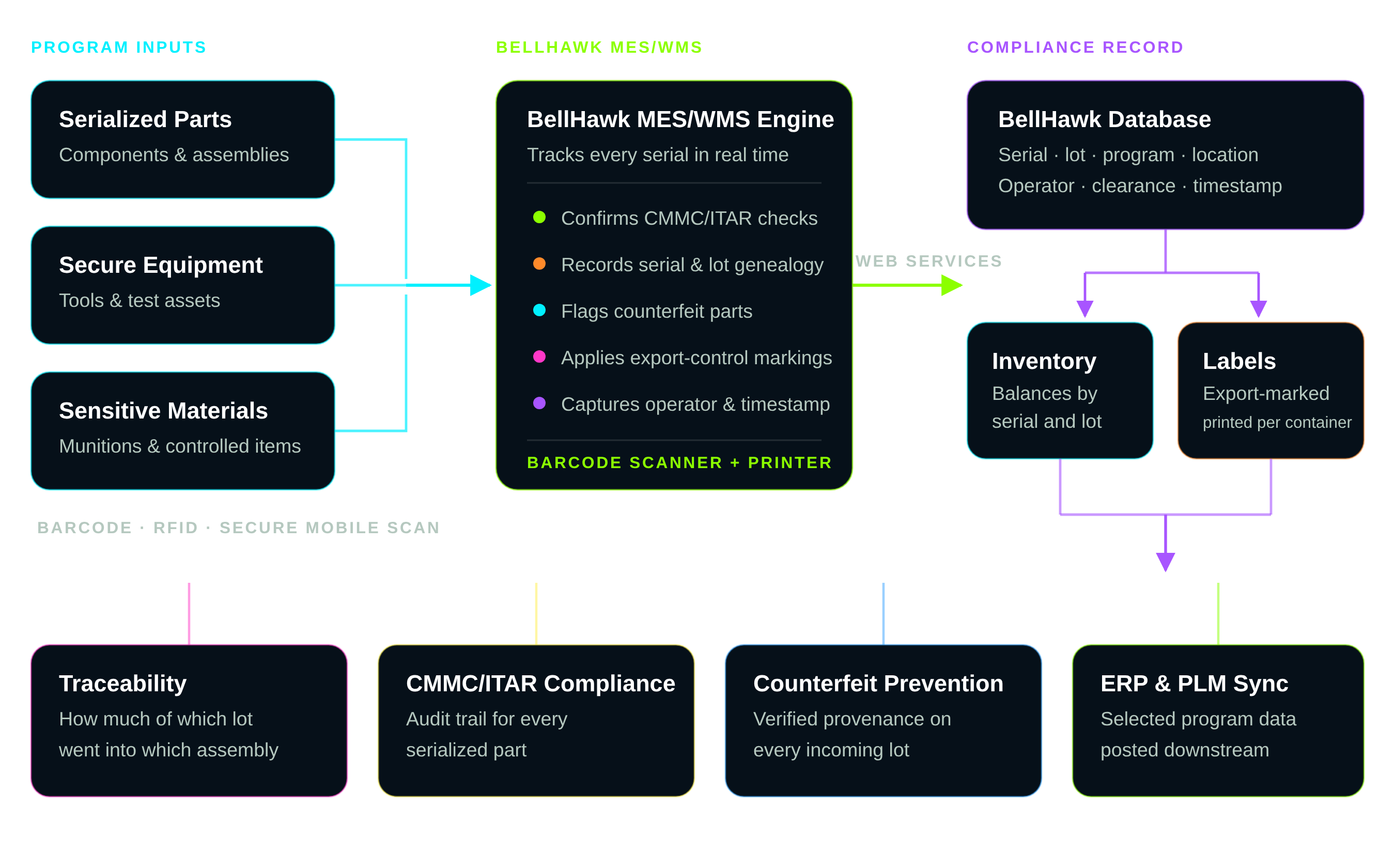
Scan at Every Handoff
Barcode, RFID, and mobile scanning at receipt, program assignment, and shipment.
Markings from the Record
Export-control markings applied at the part and container level, not retyped per label.
Selected Data to ERP
Program data shared with ERP and PLM on your schedule, through controlled integration.
Serialized Parts Tracking with Defense Traceability Solutions
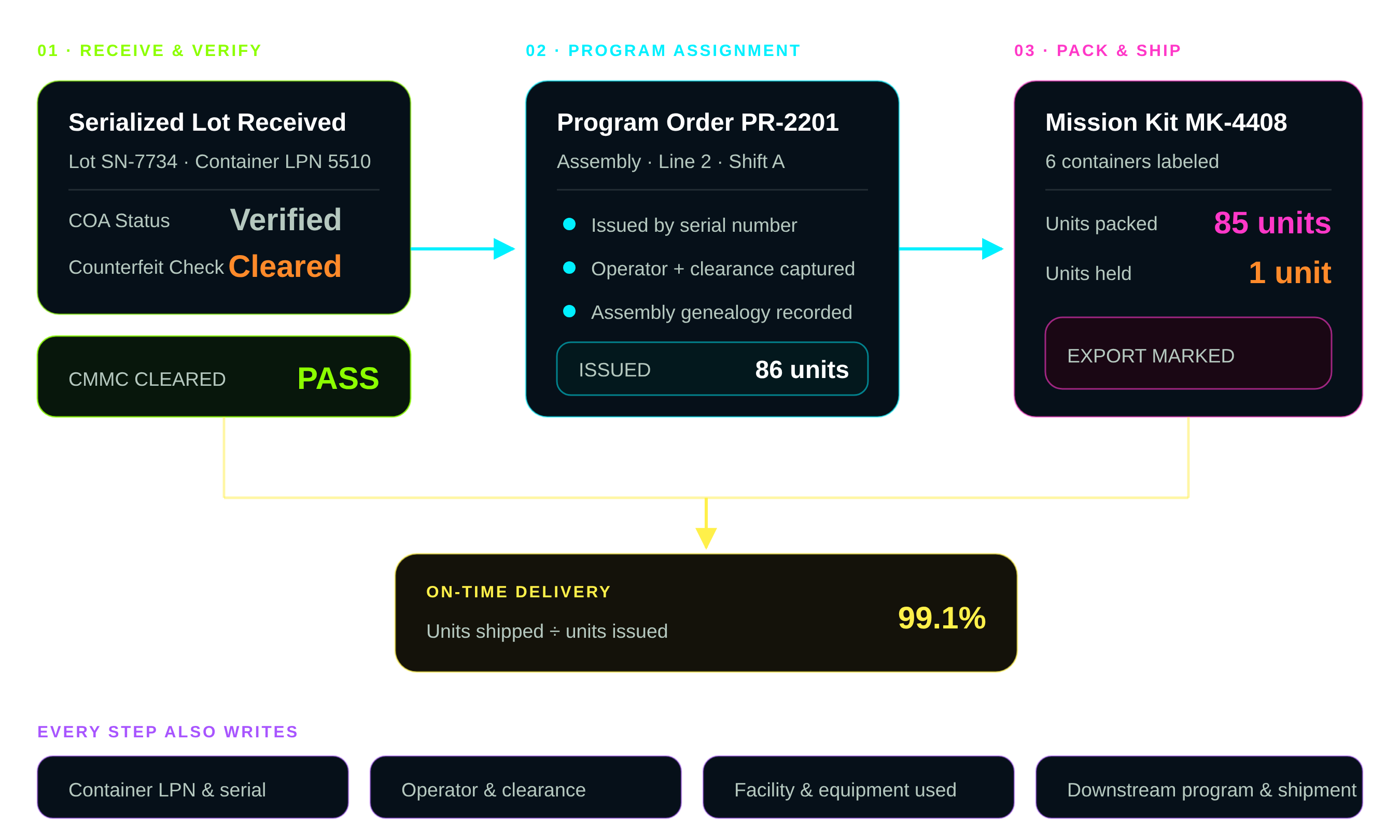
Serialized parts tracking starts at the receiving dock. Identifiers are captured before a part is issued to a program, so every later event (an assembly, a pack, a shipment) has somewhere to attach.
Receive and verify
Serialized lots are scanned, the Certificate of Conformance and supplier are checked, and the lot is released or held before it enters inventory.
Program assignment
Parts are issued to a program order by serial number, with the operator, time, and assembly genealogy recorded at issue.
Pack and ship
Finished kits are packed, export-marked, and shipped, with units shipped compared against units issued for delivery tracking.
Deployment Options for Secure Defense Facilities
Not every defense facility can or should run a continuously connected cloud system. The traceability system should fit your security posture, not the other way around. See secure hybrid manufacturing software for more on deployment.
On-Premises
Runs on hardware inside your facility, so scanning, lookups, and reporting don't depend on the public internet. Where required, it can run on an isolated (air-gapped) network with no connection to outside networks.
Offline Capture
Mobile scanners keep capturing serial and lot data when a network connection drops, then synchronize when connectivity returns.
Hybrid
An on-premises system of record with selected outside connectivity for reporting and ERP sync, where your security requirements allow it.
CMMC Compliance Software vs. Defense Traceability Solutions: What KnarrTek Supports
Many buyers search for CMMC compliance software or ITAR compliance software. No software makes a contractor compliant on its own. Defense traceability solutions support documentation; they do not certify compliance. KnarrTek does not perform CMMC assessments, classify items under ITAR or EAR, or replace a NIST SP 800-171 security assessment. It keeps the serial, lot, marking, user, and shipment records behind those programs organized and retrievable. Compliance responsibility remains with the customer, working with qualified cybersecurity, legal, and export-control professionals.
Where CMMC Compliance Software Fits
CMMC compliance software is often a security or documentation tool; KnarrTek covers the operational side. Structured, user-stamped records of how parts were received, issued, held, and shipped support the operational side of a CMMC readiness effort.
ITAR Compliance Software Support for Markings
Where teams look for ITAR compliance software for labeling, KnarrTek keeps markings consistent. Markings come from the record configured for each part or program, with a history of what was marked and shipped. Classification decisions stay with your export-control team.
Counterfeit Parts Prevention at Receipt
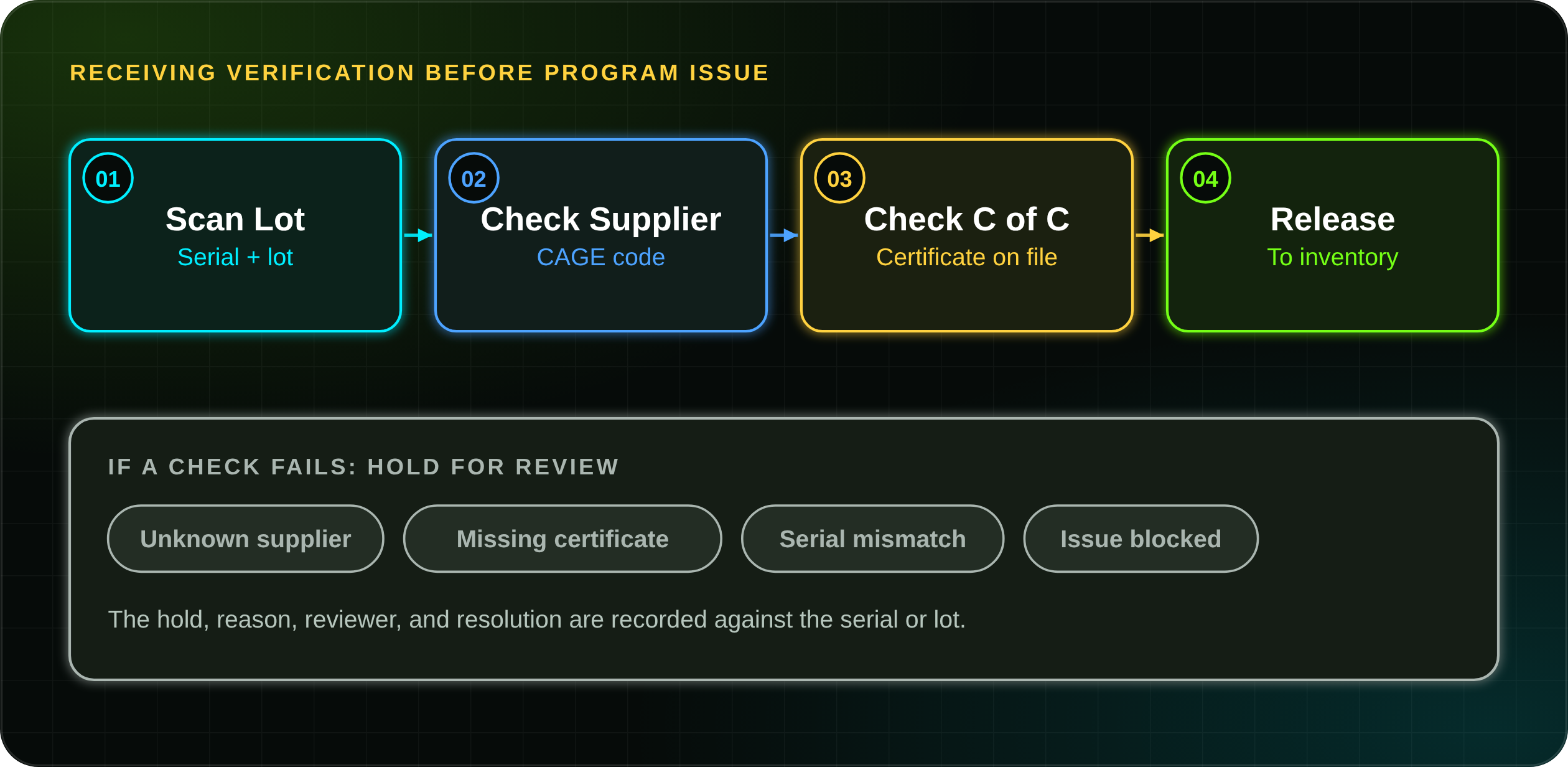
Counterfeit parts prevention starts at receiving: supplier, CAGE, and certificate checks put suspect parts on hold before they can be issued to a program.
Authoritative references: the DoD CIO CMMC program page for current phase and requirements, the State Department DDTC ITAR page, and NIST SP 800-171. Requirements change, so check these sources for what's in force today.
Trace Any Serial Forward to Shipment or Back to Its Supplier
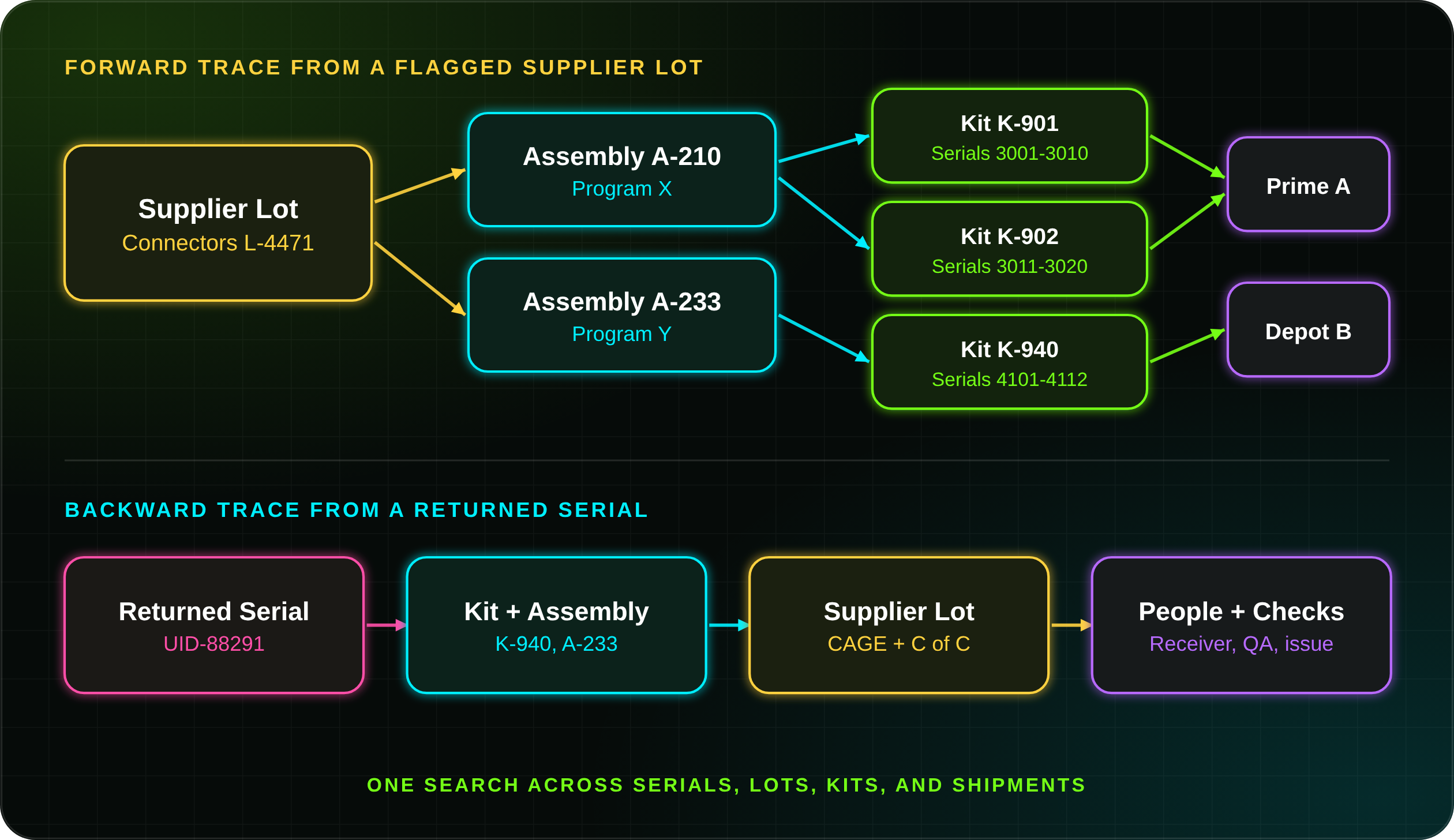
When a supplier lot is flagged, find every assembly, kit, and shipment that used it. When a part comes back, see the lot, supplier, certificate, operator, and checks behind it, in one search instead of a multi-day investigation.
Where MilramX extends BellHawk.
MilramX adds rules-based automation and system integration on top of BellHawk's serial and inventory data. It connects that data to ERP, PLM, and program systems, organizes it for reporting, and flags problems such as a delayed part shipment or a missed check as they happen.
- Intelligent agents handle routine alerts and data transfers.
- Data integration pulls ERP, PLM, and program data into one view.
- Operations visibility into program orders, shipments, and delivery status.
- Exception handling detects and escalates missed checks.
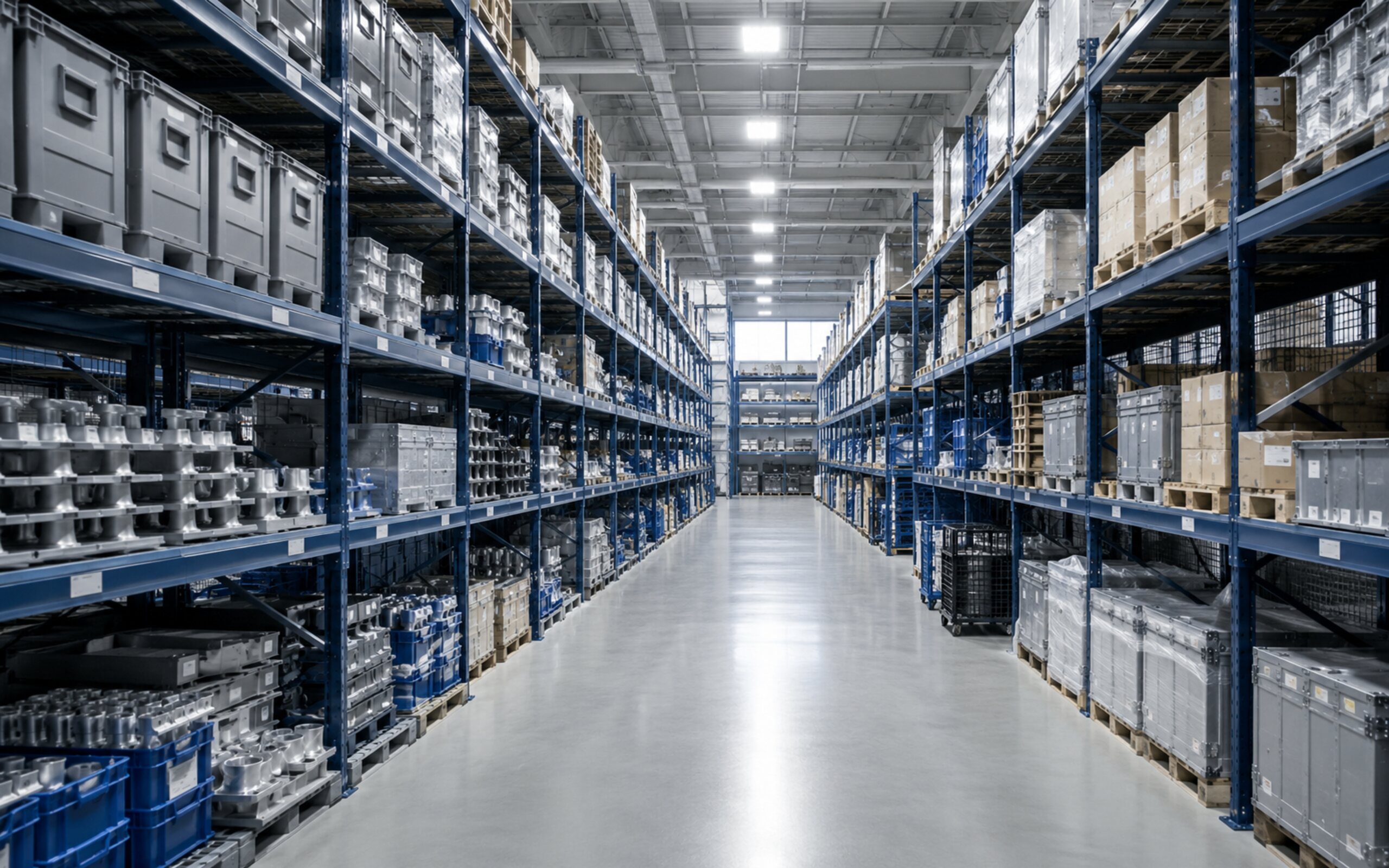
Benefits of KnarrTek Defense Traceability Solutions
BellHawk and MilramX address the pressures defense contractors face: changing requirements, counterfeit and non-conforming parts risk, and the manual effort of proving a part was handled the way it was documented.
Real-Time Visibility
Current stock, serial, and shipment status helps keep program deliveries on schedule.
Less Manual Overhead
Fewer manual errors and less time rebuilding records by hand, without adding headcount.
Audit-Ready Records
Complete, user-stamped records support CMMC readiness and ITAR recordkeeping reviews.
Error Prevention
Scan confirmation at every step catches the wrong serial or wrong kit before it moves on.
Supply Chain Coordination
Program and production teams share a current view of part supply and status.
Faster Investigations
Serial-level genealogy turns an audit or program review into a search instead of a manual hunt.
Two Ways Defense Traceability Solutions Are Deployed
These are representative patterns, not a specific contractor's results, described so you can recognize which one looks like your operation.
Program parts tracked by serial through assembly
A station has a barcode or RFID scanner and a mobile device. The operator scans the program order, then each part's serial as it's issued. BellHawk records the serial against the assembly and confirms the part was released at receiving before it can be used. The finished kit goes into a labeled container that carries its identity through packing and shipment.
Intended to improve: issue accuracy, no handwritten part logs, and complete serial and lot genealogy for every kit.
Traceability without a live outside connection
A controlled-access facility runs BellHawk on an isolated internal network. Mobile scanners capture serial, lot, and operator data locally where a station has no live connection, then synchronize when the device reaches the internal network, while MilramX watches for missed checks once data lands.
Intended to improve: continuous capture regardless of connectivity, fewer paper backup procedures, and one synchronized record.
These are representative patterns, not guaranteed outcomes. Results depend on facility layout, hardware and network conditions, process design, scope, data quality, integrations, procedures, training, and user adoption.
Three Ways to Run Defense Traceability Solutions
The right fit depends on how much of your operation runs through the system, how you need to deploy it, and how much automation you want around exceptions.
BellHawk Online
Browser-based tracking for inventory, materials, barcode scans, and production, alongside your ERP, with no local server to maintain.
Best fit: smaller suppliers without isolated-network requirements.
WIPtracker
In-plant MES and WMS for production, warehouse, quality, labeling, barcode and RFID, and serial traceability on your own network.
Best fit: facilities needing full shop-floor control and on-premises or isolated deployment.
SmartOps24x7
BellHawk plus MilramX agents for rules-based alerts, around-the-clock monitoring, and automated data exchange across connected systems.
Best fit: contractors running several systems that need automated exception handling and ERP sync.
Serial Traceability Is One Part of a Larger Record
Most defense deployments combine two or three of these capabilities.
Real-Time WIP Tracking
A part's status stays current wherever it sits in production.
View WIP Tracking CapabilityInventory and Asset Tracking
The inventory record every serial transaction posts into.
View Inventory Tracking CapabilityRFID Tracking
Hands-free identification where barcode scanning alone is impractical.
View RFID Tracking CapabilityTrack and Trace Materials
Serial and lot genealogy linking each incoming part to the assembly it became.
View Track and Trace CapabilityMaterials Flow and Job Tracking
Movement and job progress that give serial transactions their context.
View Job Tracking IndustryAerospace Traceability
The same serial-level approach for aerospace parts, certifications, and programs.
View AerospaceStop Rebuilding Serial Records After the Fact
Start with the facility or records gap causing the most trouble. KnarrTek's defense traceability solutions team will help map your parts, programs, serial records, labels, and integrations, on-premises, isolated, or hybrid, and you'll get quick, friendly answers from people who know the software.
- Serial and lot genealogy
- Barcode and RFID
- Counterfeit holds
- On-premises ready
Frequently Asked Questions About Defense Traceability Solutions
Practical answers about CMMC, ITAR, counterfeit parts, deployment, and what BellHawk and MilramX track once a serialized part starts moving.
What are defense traceability solutions?
Defense traceability solutions combine manufacturing execution (MES) and warehouse management (WMS) functions to track serialized parts, secure equipment, and controlled materials by serial and lot number, from receipt through program issue and shipment. KnarrTek delivers them through BellHawk for barcode, RFID, and mobile data capture and MilramX for automation and ERP and PLM integration on top of that data.
Who uses defense traceability solutions?
Prime contractors, subcontractors, machine shops, electronics and electromechanical assemblers, repair depots, and distributors in the defense supply chain use them to keep serial and lot records, control program inventory, and answer prime and program-office questions quickly.
Is CMMC certification currently required?
CMMC requirements are being phased into DoD contracts over time, and the required level and assessment type depend on the contract and the information you handle. Because the timeline has changed before, check the official DoD CIO CMMC program page for the current phase. KnarrTek supports the operational recordkeeping behind CMMC readiness; it does not assess or certify compliance.
Is KnarrTek CMMC compliance software?
Not in the sense of making you compliant. Buyers often search for CMMC compliance software or ITAR compliance software, but no software certifies a contractor. KnarrTek defense traceability solutions handle the operational records (serialized parts tracking, receiving checks, user-stamped transactions, and shipment history) that a CMMC or ITAR program relies on, alongside your security tools, policies, and assessor.
What is serialized parts tracking?
Serialized parts tracking records each individual part by its unique serial number as it is received, inspected, stored, issued to an assembly, packed, and shipped. Each scan adds to that serial's history, so you can see where any part is now and everything that happened to it.
Does KnarrTek provide CMMC certification or assessments?
No. KnarrTek does not perform CMMC assessments, act as a C3PAO, or issue certifications. Defense traceability solutions support documentation and controlled operations; compliance responsibility remains with the customer, working with qualified cybersecurity and compliance professionals.
Does this help with ITAR compliance?
BellHawk applies export-control markings to serialized parts and shipments based on the record configured for each part or program, and keeps a consistent history of what was marked and shipped. It does not classify items or replace legal review of your export decisions, which stay with your export-control team. See the State Department DDTC ITAR page for current requirements.
How does this relate to DFARS and NIST SP 800-171?
DFARS clause 252.204-7012 requires contractors to safeguard covered defense information under NIST SP 800-171, which is the basis for CMMC Level 2 assessments. BellHawk and MilramX support the recordkeeping and traceability practices around that baseline; they are not a substitute for a NIST SP 800-171 security assessment or System Security Plan.
Can defense traceability solutions print MIL-STD-130 UID labels?
BellHawk can print part, container, and export-control labels from the serial and program data on file, including label formats configured for MIL-STD-130 unique item identification. Your marking requirements, data matrix content, and label stock are confirmed during implementation.
Does it support barcode and RFID, or do we have to choose one?
Both. BellHawk reads barcode and RFID data side by side, so a facility can scan barcodes where practical and use RFID where hands-free or bulk reads make more sense, on the same serialized part, without running two systems.
What happens when a counterfeit or non-conforming part is detected?
BellHawk holds the part so it cannot be issued to a program order until it is reviewed. The hold, the reason, the reviewer, and the resolution are recorded against the part's serial number, giving quality a documented history instead of a verbal explanation after the fact.
How does counterfeit parts prevention work in defense traceability solutions?
Incoming lots are checked at receiving against the supplier, CAGE code, and Certificate of Conformance, and the result is recorded against the serial or lot. Because the check happens at receipt, a suspect part is held before it can be issued, rather than relying on downstream inspection alone.
Can this run in an air-gapped or offline facility?
BellHawk can run entirely on-premises with no required internet connection, including on an isolated internal network. Mobile scanners can keep capturing data when a station loses its connection and synchronize once they reach the network again. Exact device, network, and synchronization behavior should be reviewed for your facility during design.
What's the difference between on-premises and air-gapped?
On-premises means the software runs on hardware inside your facility. Air-gapped is stricter: the network has no physical or logical connection to the internet or outside networks at all. KnarrTek can run on-premises, and where a facility requires it, on an isolated network.
Can defense traceability solutions track kits and assemblies by serial?
Yes. Components can be scanned into assemblies, kits, and shipping containers with parent-child relationships preserved, so any shipped kit can be traced to the serials inside it and each serial back to its supplier lot.
Can it track tools and equipment as well as parts?
Yes. Secure equipment, tools, test gear, and other high-value assets can be tracked by barcode or RFID for location, custodian, status, and movement history alongside part inventory.
Can different programs or customers be kept separate?
Yes. Program orders, inventory, and records can be separated by program or customer, so each program's serial history and shipments can be reviewed on its own and access can be limited by role.
What's the difference between BellHawk and MilramX?
BellHawk is the MES and WMS layer that captures barcode, RFID, and mobile scan data at receipt, issue, and shipment. MilramX sits on top of that data, adding rules-based automation, alerts, and integration with ERP, PLM, and program systems. Most contractors start with BellHawk and add MilramX when they need automated cross-system coordination.
Can this integrate with our existing ERP or PLM system?
Yes. MilramX connects BellHawk's serial and inventory data to ERP, PLM, CRM, and program systems, and selected data can also be posted from BellHawk directly. KnarrTek works alongside your existing systems rather than replacing them, and you control which data is shared.
Which KnarrTek package fits a defense contractor?
WIPtracker fits facilities that need on-premises or isolated deployment with full shop-floor control and serial traceability. BellHawk Online fits smaller suppliers without isolated-network requirements. SmartOps24x7 fits contractors running several connected systems that need automated alerts and ERP synchronization.
What does implementation typically involve?
Typically: confirming part master data, program structure, and recordkeeping requirements; setting up barcode, RFID, and mobile scanning at receiving, program assignment, and shipment; configuring receiving checks and labels; agreeing what data flows to ERP or PLM; and training operators on the scan sequence and any offline procedures. Most facilities start with one program line and expand.
Where is KnarrTek located?
KnarrTek's corporate office is in Millbury, Massachusetts, with a second office in Panama City, Florida. KnarrTek operates globally, with current accounts in Mexico and Canada, and supports defense suppliers across the United States.
How do we get started with KnarrTek defense traceability solutions?
Contact KnarrTek to request a traceability review. Share your programs, part types, deployment constraints, ERP system, and where serial records break down today. The KnarrTek team will recommend the right package, deployment, and first workflows, and answer questions quickly and in plain language.
