

Chemical Traceability Solutions for Batch, Material, and Quality Visibility
KnarrTek chemical traceability solutions connect raw materials, supplier lots, containers, batches, work-in-process, quality status, labels, and shipments in real time, for specialty chemical producers, batch processors, blenders, toll manufacturers, repackagers, and chemical distributors.
Operators capture activity where the work happens with barcode, RFID, mobile, scale, and label workflows. Selected data is then shared with ERP, LIMS, quality, reporting, and shipping systems.
- Lot and Batch Genealogy
- Barcode and RFID
- Quality Status Control
- ERP and LIMS Integration
What Are Chemical Traceability Solutions?
Chemical traceability solutions create a connected digital history for raw materials, formulations, production batches, work orders, operators, equipment, quality events, containers, labels, and customer shipments. They show which source lots went into a batch, where material moved, what process step occurred, which quality status applied, and which finished lots or shipments may be affected. KnarrTek captures these transactions through configured barcode, RFID, mobile, workstation, scale, label, and integration workflows, so the record is searchable from receiving through distribution.
Source-to-Batch Genealogy
Connect supplier lots and containers with batches, intermediates, finished products, and shipments.
Real-Time Batch Status
See active, waiting, held, tested, released, packaged, or completed work as it happens.
Quality Status Visibility
Connect quarantine, sampling, approval, rejection, rework, and release decisions to real lots.
Connected Operations
Exchange selected records with ERP, LIMS, reporting, shipping, and customer systems.
Build Chemical Traceability Solutions Around the Transactions That Matter
Effective chemical traceability solutions do more than store finished-batch records. They capture material identity, process activity, status changes, container relationships, and system updates while the operation is moving.
Identify
Assign or capture material, lot, batch, container, asset, location, and work-order identifiers.
Transact
Record receiving, movement, issue, dispense, consumption, output, return, adjustment, and shipment.
Validate
Apply configured checks for identity, quantity, status, location, expiration, label, and destination.
Connect
Link source lots with recipes, batches, quality decisions, containers, finished lots, and customers.
Respond
Use current records, reports, alerts, and integrations to investigate exceptions and coordinate action.
Capture the chemical activity your business systems don't see in real time.
ERP platforms manage purchasing, item masters, formulas, orders, and financial transactions. LIMS platforms manage samples and results. Important details still happen between those systems: chemicals are received, relabeled, transferred, staged, weighed, dispensed, blended, reacted, sampled, held, packaged, and shipped before every event reaches the system that needs it.
Chemical traceability solutions close that gap. Operators record transactions with barcode scanners, RFID readers, rugged mobile devices, shared workstations, label printers, connected weigh scales, and equipment. Selected data is then validated, reported, or exchanged with authorized systems.
- Capture material, labor, equipment, batch, quality, label, container, and shipment activity.
- Control with configured identity, location, status, expiration, quantity, and workflow checks.
- Connect ERP, LIMS, QMS, reporting, shipping, databases, devices, and customer systems.
- Communicate current status to production, warehouse, quality, planning, and IT teams.
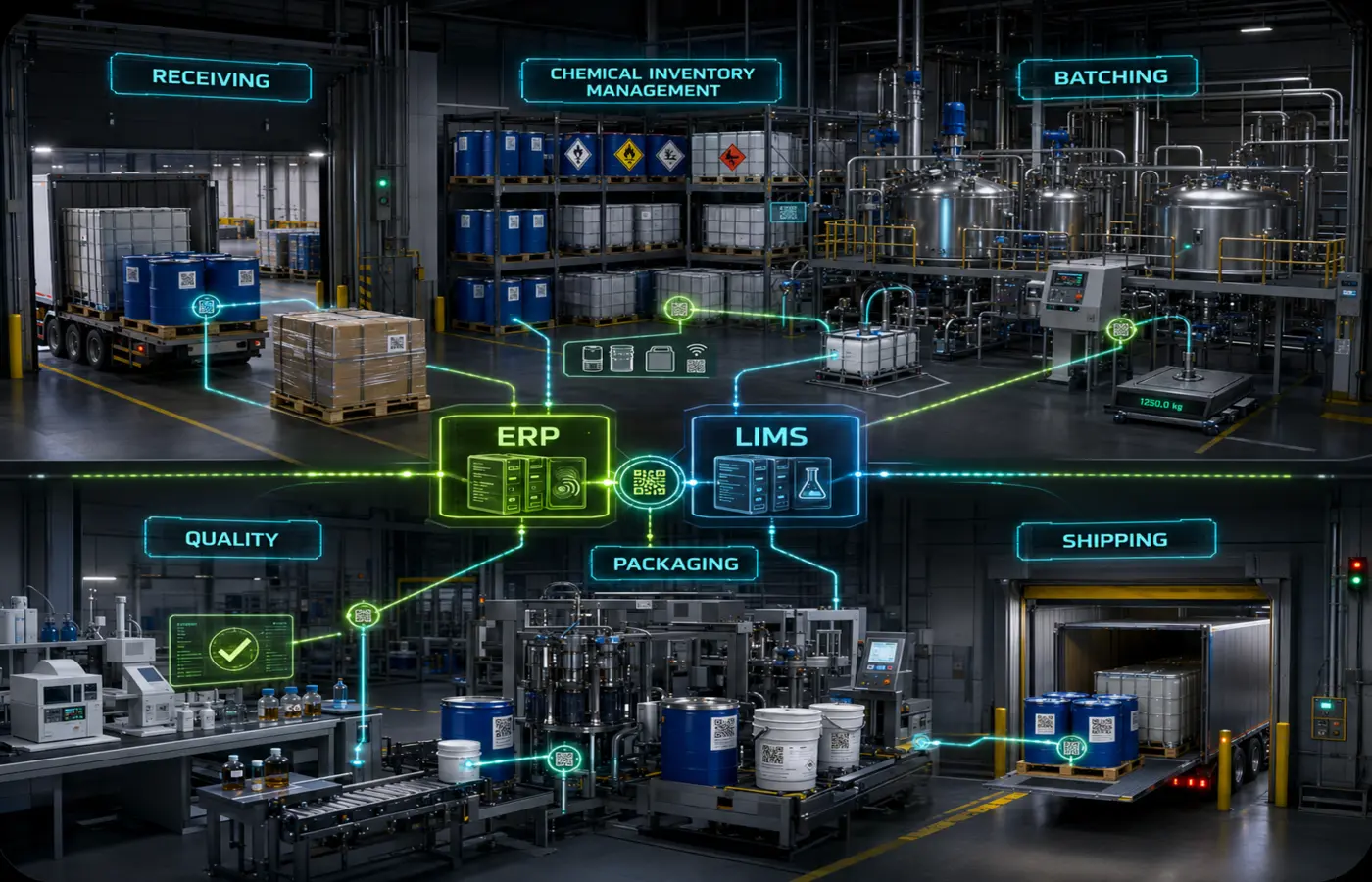
What Do Chemical Traceability Solutions Record at Each Stage?
Each production stage adds information to the batch record. Here is what KnarrTek captures at every stage and why it matters to your team.
Starts the record for every received lot
Supplier, purchase order, material, quantity, lot, expiration or retest date, container, and starting status.
Shows where material is and whether it can be used
Current location, container, quantity, status, transfers, staging, and barcode or RFID movements.
Proves which source lot and quantity went into each batch
Material, source lot, production batch, planned and actual weight, operator, scale or device, and time.
Gives real-time WIP status and a searchable production history
Process steps, labor, equipment, materials used, output, yield, scrap, rework, and completion.
Shows whether each lot is approved, restricted, or ready
Samples, tests, holds, approvals, rejections, releases, and final disposition.
Connects each finished batch and container to the right shipment
Finished lot, container, quantity, label, pallet, customer order, destination, and shipment.
Chemical Traceability Solutions Built Around Real Material and Batch Transactions
KnarrTek is configured around the identifiers, formulas, routes, quality states, labels, devices, reports, and integrations your facility already uses. Each transaction becomes part of one searchable record that supports hazardous material tracking, chemical inventory management, and batch visibility.
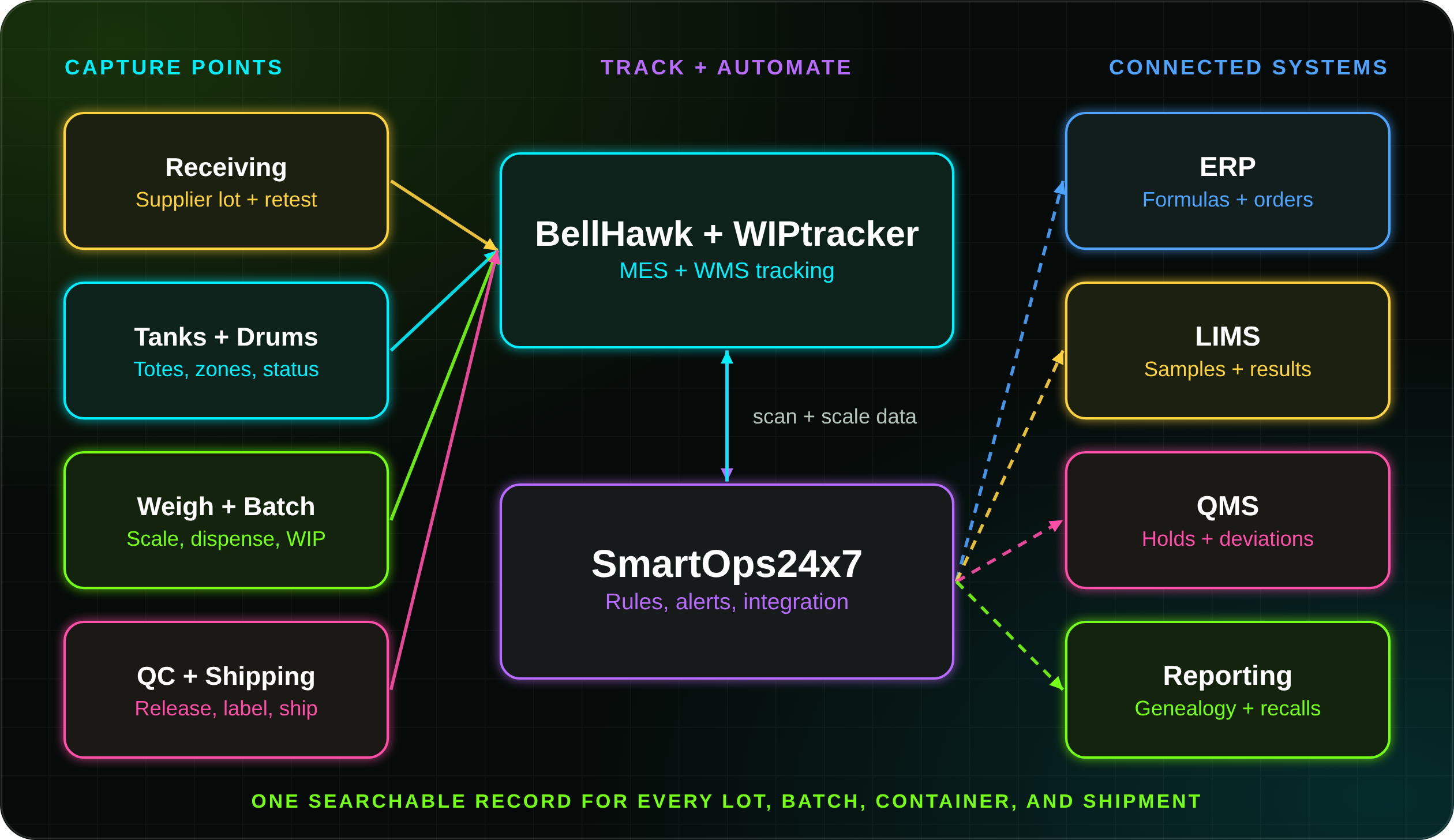
Chemical Inventory Management
- Raw chemicals, intermediates, and finished goods
- Tanks, totes, drums, rooms, and zones
- Lot, quantity, retest date, and status
Batch Traceability Software
- Source lots to dispensed material
- Process steps, outputs, and packaged lots
- Forward and backward trace searches
Real-Time WIP Tracking
- Batch, work order, and route status
- Labor, equipment, and material use
- Yield, scrap, rework, and completion
Hazardous Material Tracking
- Chemical identity, lot, and container
- Storage location, movement, and use
- Return and disposal-related records
Barcode and RFID Tracking
- Direct barcode confirmation
- Contactless RFID for containers and pallets
- Hybrid workflows for each area
Quality and Status Records
- Quarantine, sampling, and testing
- Approval, rejection, and rework
- Release and disposition history
Labeling and Container Control
- Drum, tote, tank, box, and pallet labels
- Configured label generation and printing
- Scan verification before shipment
Automation and Integration
- ERP, LIMS, QMS, and database exchange
- Scales, printers, and readers
- Rules, alerts, and monitoring
How Chemical Traceability Solutions Follow Material from Supplier Receipt to Shipment
Chemical traceability solutions are most useful when they preserve every handoff. KnarrTek keeps one continuous history across the warehouse, weighing, dispensing, production, quality, packaging, and distribution.
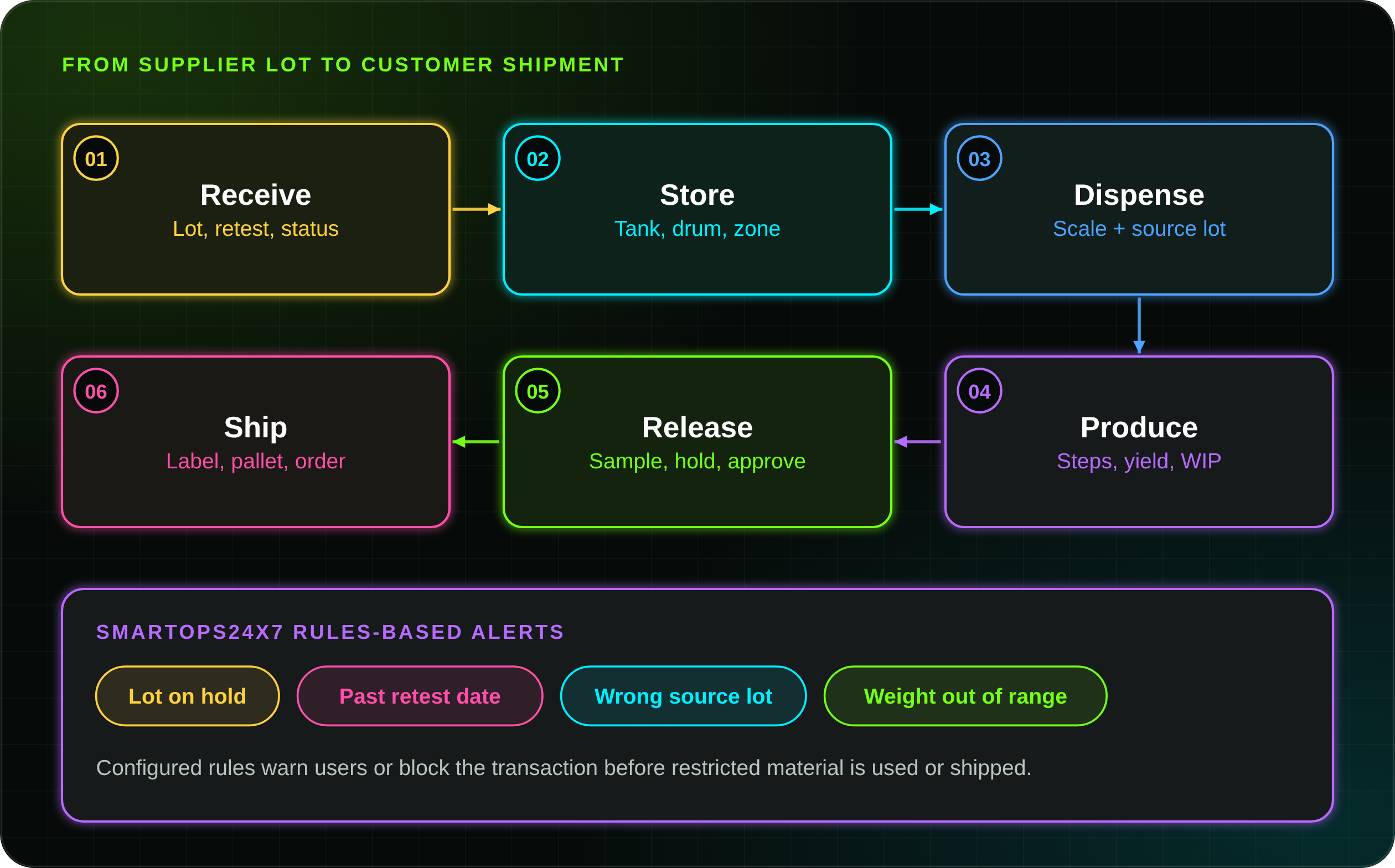
Receive
Capture supplier, order, item, quantity, lot, status, container, and applicable date information.
Store
Track putaway, location, movement, segregation, status, availability, and controlled inventory.
Dispense
Confirm source material, lot, container, batch, operator, target quantity, and actual quantity.
Produce
Connect work steps, labor, equipment, material use, output, yield, scrap, and rework.
Release
Record sampling, results, holds, approval, rejection, release, and disposition decisions.
Ship
Validate finished lots, containers, labels, customer orders, staging, loading, and shipments.
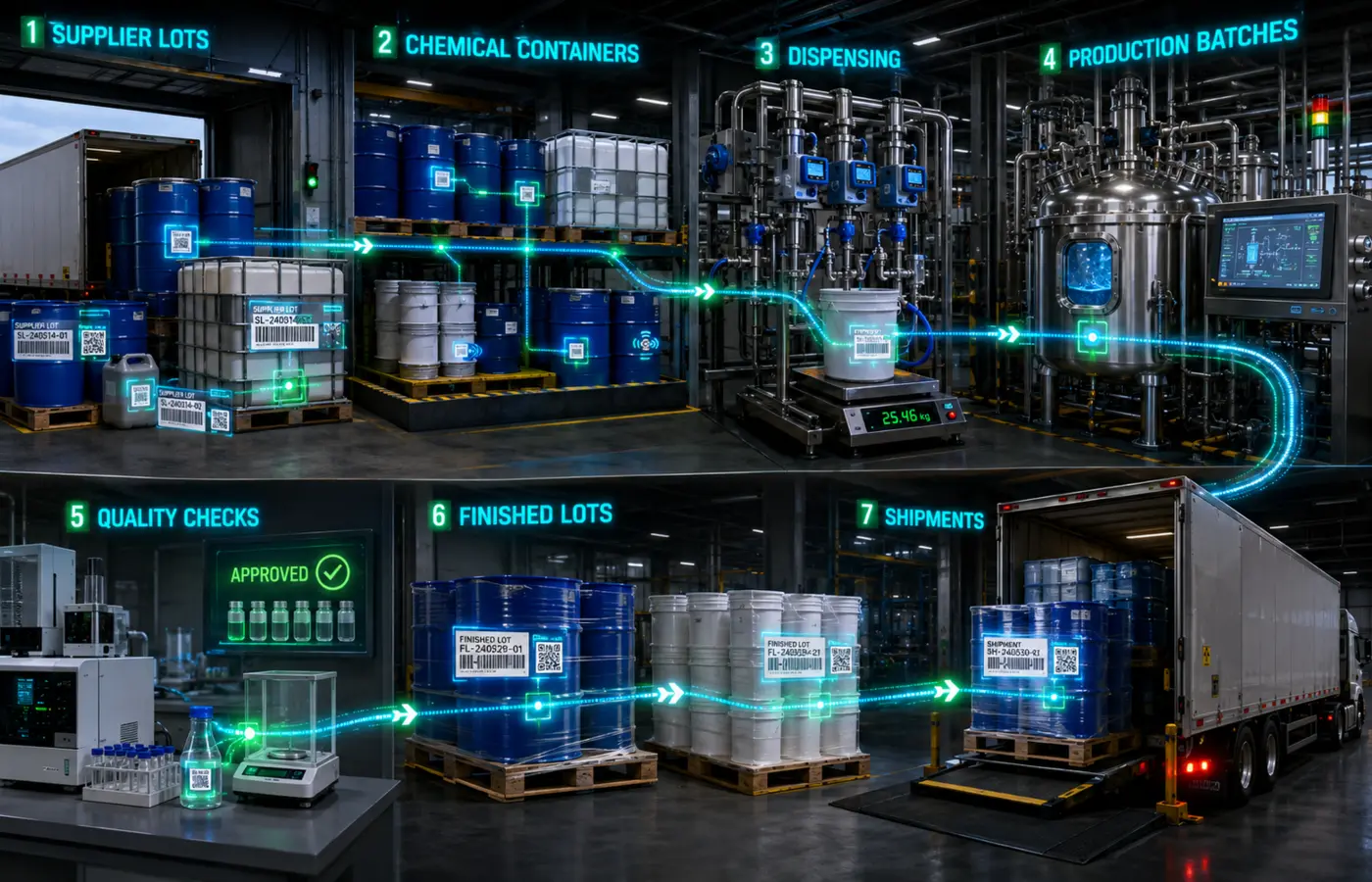
Answer batch investigation questions without rebuilding the story by hand.
Production needs current batch and material status. Quality needs sampling, hold, deviation, rework, and release history. The warehouse needs accurate locations, containers, lots, and quantities. EH&S needs reliable chemical identity and movement records. IT needs controlled interfaces, and customer-facing teams need accurate shipment answers.
- Backward trace: find the supplier lots, containers, transactions, people, and equipment behind a finished lot.
- Forward trace: find the batches, containers, inventory, orders, and shipments that used a source lot.
- Status trace: see when material entered quarantine, testing, approval, rejection, release, or disposition.
- Container trace: connect drums, totes, tanks, intermediates, packaged units, pallets, and shipments.
- System trace: monitor data exchange, alerts, reports, and integration exceptions.
How Chemical Traceability Solutions Support Batch Production and Container Inventory
These examples illustrate representative workflows based on KnarrTek tracking capabilities. They are planning examples, not named-customer testimonials, guaranteed savings, or claims about a current customer implementation.
Source-lot genealogy from receiving through packaged finished product
A specialty chemical operation needs to replace paper travelers and disconnected spreadsheets while linking source material, dispensing, batch production, quality status, packaging, and shipment.
- Capture supplier lots, storage containers, movement, weigh or dispense activity, operators, and batches
- Track intermediate output, yield, rework, quality status, packaged containers, labels, pallets, and shipments
- Exchange selected item, order, inventory, batch, and shipment updates with ERP, LIMS, or reporting
Expected operational value: less manual reconstruction, and faster answers to source-lot, inventory, quality-status, and customer-shipment questions.
Container, status, location, and lot visibility across storage and shipping
A chemical supplier or processor needs chemical inventory management across drums, totes, tanks, pallets, storage zones, production staging, and customer orders.
- Track container ID, contents, lot, quantity, location, ownership, status, retest date, and movement
- Use barcode and RFID for receiving, transfer, staging, issue, return, cycle count, picking, packing, and shipping
- Validate product, container, order, label, destination, and shipment relationships before dispatch
Expected operational value: less time searching for material or reconciling late spreadsheets, and faster answers about which inventory or shipments carry a given lot.
Actual results depend on workflow design, implementation scope, data quality, integrations, devices, infrastructure, procedures, training, security, and user adoption.
Support Labeling, Inventory, and Recordkeeping Programs with Accurate Data
Chemical traceability solutions support documentation; they do not certify compliance. KnarrTek does not classify hazards, write safety data sheets, certify ISO 9001 or REACH conformance, replace process-safety controls, or decide whether a regulation applies. It helps chemical manufacturers keep structured material, batch, user, quality-status, label, container, and shipment records inside their own operational and compliance programs. Compliance responsibility remains with the customer.
Connected identities, labels, and containers
Link configured chemical identities, labels, containers, locations, and transaction records to daily workflows. Hazard classification and SDS responsibilities remain with the regulated organization.
Production and quantity data on hand
Keep production, material, site, quantity, and use-related data that may support internal reporting where applicable. Applicability and submissions remain the manufacturer's responsibility.
Genealogy and status history
Strengthen lot genealogy, status history, user activity, labels, and searchable records that can support your quality system and supply-chain obligations.
Authoritative references: the OSHA Hazard Communication overview, OSHA 29 CFR 1910.1200, and EPA Chemical Data Reporting. Each organization is responsible for deciding which rules apply and how its systems, procedures, records, labels, and reports must be controlled.
Match Your Chemical Traceability Solutions to the Control You Need
KnarrTek offers cloud, on-premise, and connected packages for different levels of chemical inventory management, batch process management, traceability, automation, integration, and monitoring. The right fit depends on workflow, deployment, devices, integration, and security needs.
BellHawk Online
Browser-based inventory, production, labor, material, barcode, asset, and job tracking for teams that want practical visibility without a large IT project.
Best fit: focused cloud tracking, shared devices, and phased improvement.
WIPtracker
MES and WMS workflows for WIP, inventory, batch traceability, quality status, labeling, job records, barcode, RFID, and in-facility operations.
Best fit: deeper local control, detailed batch records, and offline-capable capture.
SmartOps24x7
Rules-based automation, alerts, data exchange, ERP and LIMS integration, transformation, reporting, and monitoring for complex environments.
Best fit: multi-system operations, automated exception handling, and controlled data exchange.
Chemical Traceability Solutions for Specialty, Batch, Blending, and Distribution Operations
KnarrTek supports make-to-stock, make-to-order, batch, continuous, toll, contract, and hybrid operations, configured around each facility's identifiers, controls, devices, processes, labels, and customer requirements.
Source lots, formulas, dispensing, batches, quality status, packaging, labels, and customer shipments.
Ingredients, colors, viscosities, batches, containers, tests, packaged units, and customer requirements.
Raw materials, tank or mixer assignment, weighment, blend steps, yield, sampling, release, and transfer.
Separate customers, owner inventory, work orders, formulas, labels, reports, and finished-product records.
Ingredient lots, batching, filling, container identity, quality status, labeling, pallets, and distribution.
Raw-material genealogy, process history, intermediate lots, test status, packaging, and shipment records.
Container, location, lot, status, quantity, expiration, allocation, picking, packing, and shipping.
Source containers, transfers, new containers, labels, lots, quantities, pallets, orders, and shipments.
Explore the Tracking Capabilities Behind Chemical Traceability Solutions
Review the KnarrTek pages that cover real-time WIP tracking, chemical inventory management, RFID tracking, material genealogy, barcode capture, and job tracking in more technical detail.
Manufacturing Tracking
Work orders, WIP, inventory, source materials, labor, lots, labels, quality, and shipments.
Explore Capabilities CapabilityReal-Time WIP Tracking
Work location, status, materials, labor, route progress, holds, scrap, rework, and completions.
View WIP Tracking CapabilityInventory and Asset Tracking
Receiving, putaway, locations, containers, transfers, staging, picking, and shipping.
View Inventory Tracking CapabilityRFID Tracking
Contactless reads for faster material, container, pallet, asset, and high-volume capture.
View RFID Tracking CapabilityMaterials Traceability
Lots, batches, serials, source materials, work, quality checks, labels, containers, and shipments.
View Track and Trace CapabilityMaterials Flow and Job Tracking
Job progress, labor, process steps, material usage, WIP movement, and completion status.
View Job TrackingTurn Disconnected Material and Batch Activity into a Searchable Record
Start with the operational problem. KnarrTek helps map the materials, transactions, identifiers, containers, devices, users, labels, reports, alerts, and integrations needed to build chemical traceability solutions around your actual facility. You'll talk with people who know the software, and you'll get a quick, clear answer.
- Supplier lot to shipment
- Barcode, RFID, and scales
- Quality status control
- ERP and LIMS connected
Frequently Asked Questions About Chemical Traceability Solutions
Answers for chemical operations, production, quality, warehouse, EH&S, and IT teams comparing chemical traceability solutions, batch traceability software, hazardous material tracking, chemical inventory management, labeling, and ERP or LIMS integration.
What are chemical traceability solutions?
Chemical traceability solutions are software workflows that build a connected digital history of raw materials, supplier lots, containers, formulations, batches, work-in-process, quality decisions, labels, and shipments. They let authorized teams see which source lots went into a batch, where material moved, what process step occurred, which quality status applied, and which finished lots or customer shipments may be affected.
What do chemical traceability solutions track?
Chemical traceability solutions can track raw materials, supplier lots, containers, locations, work orders, formulas, operators, equipment, WIP, batches, quality status, labels, finished products, pallets, orders, and shipments. KnarrTek connects configured records from receiving through production and distribution.
How does batch traceability software work?
Batch traceability software captures identifiers such as supplier lot, internal lot, batch, container, barcode, RFID tag, work order, and finished-lot number. Receiving, movement, dispensing, consumption, production, inspection, packing, and shipping events are then connected to those identifiers, so a finished lot can be traced back to its sources and a source lot can be traced forward to every batch and shipment that used it.
How is chemical traceability different from chemical inventory management?
Chemical inventory management answers what you have, how much, and where it is right now. Chemical traceability adds the history: which lots were consumed by which batches, who handled them, what quality decisions were made, and where the finished product went. KnarrTek handles both in one record, because every inventory transaction also becomes part of the genealogy.
Can KnarrTek integrate with ERP and LIMS systems?
Yes. KnarrTek can support configurable data exchange with ERP, LIMS, QMS, accounting, shipping, reporting, databases, label systems, scanners, RFID readers, scales, and other operational platforms. The exact interface depends on the systems, data, timing, validation, and security requirements.
Does KnarrTek replace an ERP, LIMS, QMS, or EH&S platform?
Usually, no. KnarrTek is typically used as a real-time operational layer for material, inventory, batch, status, labeling, container, and traceability activity. It does not replace process-safety controls, hazard classification, SDS authorship, or the customer's compliance program. Selected transactions can be shared with authorized systems.
Does KnarrTek support barcode and RFID tracking?
Yes. KnarrTek supports barcode and RFID tracking for materials, assets, containers, work orders, locations, lots, batches, labels, pallets, and shipments. Barcode gives precise operator confirmation, while RFID can support faster contactless movement capture. Many chemical plants use both, depending on the area.
Can KnarrTek connect to weigh scales during dispensing?
Yes. Configured workflows can read weights from connected scales during weighing and dispensing, then record the material, source lot, container, target weight, actual weight, operator, and batch. This removes hand-written weights and gives a clear record of what was added to each batch.
Can KnarrTek track chemical status and expiration dates?
Yes. Configured workflows can track expiration or retest dates along with quarantine, sampling, testing, approval, rejection, release, rework, and disposition status. Rules can warn users or restrict defined transactions based on status and date requirements.
Can chemical traceability solutions stop the use of quarantined or expired material?
They can help. When a lot is on hold, rejected, or past its retest or expiration date, configured scan checks can warn the operator or block the issue, dispense, or ship transaction. The rules your quality team defines decide what is allowed, and every override can be recorded with the user and time.
Can chemical inventory management track drums, totes, and tanks?
Yes. KnarrTek can track drums, totes, tanks, bins, pallets, intermediate containers, and packaged units by identifier, contents, lot, quantity, location, status, ownership, and transaction history. Workflows can preserve parent-child and transfer relationships between containers.
How does KnarrTek handle bulk tanks and partial containers?
Bulk tanks and partially used drums or totes can be tracked by quantity, with each draw, transfer, top-up, or return recorded against the source lot. When material from more than one lot goes into a tank, the configured workflow can keep the mix history so later batches can still be traced to every contributing lot.
Can KnarrTek support hazardous material tracking?
Yes. Hazardous material tracking can connect chemical identity, lot, container, storage location, status, movement, use, return, and disposal-related records. Hazard classification, storage rules, and safety decisions remain with your EH&S team; KnarrTek provides the accurate operational record they work from.
Can KnarrTek create GHS labels or connect with label systems?
KnarrTek can support configured label generation, printing, verification, and data exchange for material, container, product, pallet, and shipment workflows. The chemical manufacturer remains responsible for hazard classification, required label content, safety data sheets, regulatory review, and approval.
Do chemical traceability solutions make a facility compliant with OSHA, EPA, ISO 9001, or REACH?
No. Software supports documentation; it does not certify compliance. KnarrTek keeps structured material, batch, user, quality-status, label, container, and shipment records that can support your programs. Each organization decides which requirements apply, and compliance responsibility remains with the customer.
How quickly can teams search lot or batch history?
Search speed depends on configuration, data volume, infrastructure, and reporting requirements. A properly designed chemical traceability workflow lets authorized users search backward from a finished lot or shipment to source materials, and forward from a source lot to affected batches, containers, inventory, or shipments.
Can KnarrTek track labor, equipment, and material usage together?
Yes. Configured workflows can connect employee activity, work orders, process steps, equipment time, material consumption, output, yield, scrap, rework, and completion records. This supports better batch visibility and planned-versus-actual reporting.
Can toll and contract manufacturers keep customer materials separate?
Yes. Toll and contract processors can track customer-owned inventory, formulas, work orders, labels, reports, and finished-product records separately by customer. That makes it easier to answer each customer's questions about their own lots without exposing other customers' data.
Can the software run in cloud, on-premise, or connected environments?
Yes. BellHawk Online provides browser-based cloud tracking. WIPtracker supports deeper on-premise MES and WMS workflows. SmartOps24x7 supports integration, automation, rules, alerts, and monitoring across complex connected environments.
Can WIPtracker capture data when internet connectivity is limited?
WIPtracker is designed for in-facility deployment and can support local data capture without depending on continuous public internet access. Exact resilience, device, network, synchronization, backup, and security requirements should be reviewed during system design.
Which chemical manufacturers are a good fit for KnarrTek?
KnarrTek can support specialty chemical manufacturers, batch processors, blenders, toll and contract manufacturers, coatings and adhesive producers, resin and polymer operations, cleaning-product manufacturers, repackagers, distributors, and warehouses that need better material, batch, inventory, or traceability visibility.
Can we start small and expand later?
Yes. Many teams start with one area, such as receiving and chemical inventory management or batch dispensing, then add production, quality status, shipping, and integrations as the workflow proves itself. A phased plan keeps training manageable and lets you show results early.
How does a chemical manufacturing implementation begin?
Implementation begins by mapping your current materials, batches, identifiers, containers, users, devices, labels, quality states, reports, exceptions, security needs, and system interfaces. KnarrTek then helps define a focused design that can expand as requirements grow.
How do we get started with KnarrTek chemical traceability solutions?
Contact KnarrTek to request a chemical workflow review. Share what you produce, how material moves today, which systems you use, and where records break down. The KnarrTek team will recommend the right package, devices, and first workflows, and answer questions quickly and in plain language.
